Naimh is a seasoned marketer of 12 years, including in SaaS and tech. She’s an expert at simplifying complex technology concepts, bridging the gap between IT and marketing. Naimh specializes in turning tech speak into actionable insights, helping marketers get the most out of their tools and technology.
Email sign-offs: Examples and how to choose the right one

TL;DR
Use "Kind regards" or "Thank you," then your name. "Kind regards" scored highest in a UK survey by Perkbox (69%) and "Thank you" in a US survey by Preply (38%). Don't skip the sign-off. In the UK survey, 44% rated no sign-off among the worst ways to end an email.
End an email in three parts: a closing line that says what happens next, a sign-off, and your email signature.
In British English, "Yours sincerely" goes with a named reader and "Yours faithfully" with an unknown one. American English uses "Sincerely" or "Sincerely yours."
Replies and preferences can differ. Boomerang's analysis found that thankful closings got more replies. In a US survey, "Thanks in advance" ranked last for preference, at 5%.
"Email isn't being abandoned; it's being reserved. People are very intentional about which channel they use. Casual, fleeting moments go to WhatsApp or text. Anything high-stakes, anything they want to refer back to or keep a record of, goes to email. People reach for it when the stakes are high enough to justify it, because they understand it creates a permanent, referenceable record."

How do you end an email?
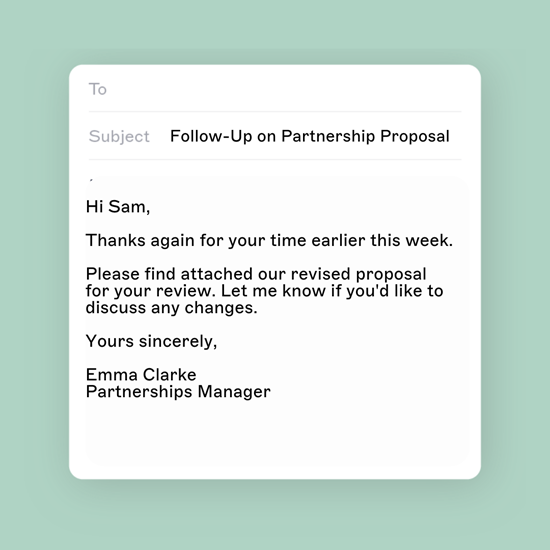
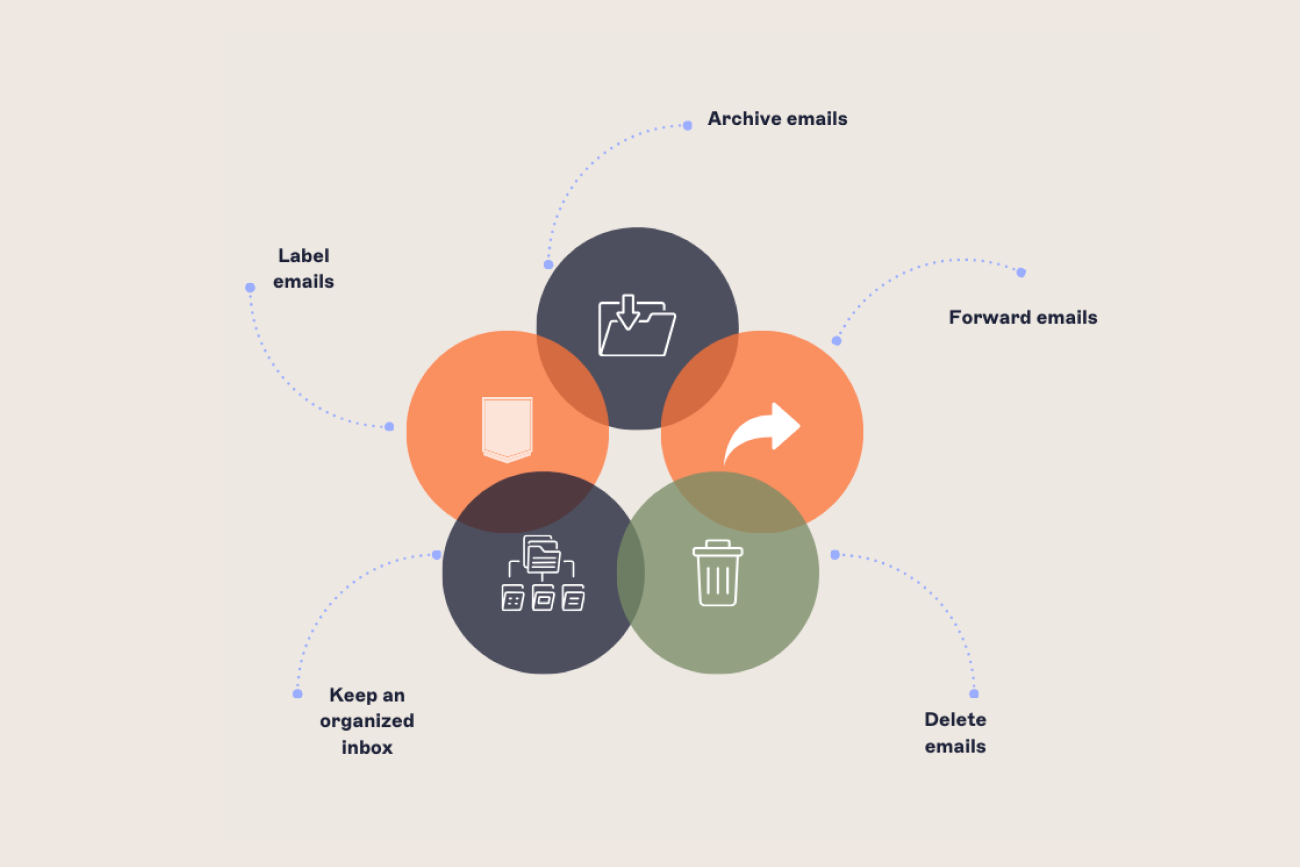
An email ends in three parts, in this order: a closing line, a sign-off, and an email signature. To close an email, use all three.
Part | What it does | Example |
|---|---|---|
Closing line | Says what happens next or what you need | "Could you send this by Friday?" |
Sign-off | Closes the message before your name | "Thank you," |
Email signature | Gives your name, job title and contact details | Jane Smith, Account Manager, +1 555 0100 |
Grammarly says you don't need to type your name after the sign-off if you have an email signature. For what to put in one, see our guides to contact details dos and don'ts and professional email signature examples.
Source: Grammarly's guide to ending a letter, updated November 2024.
How do you sign off an email by situation?
Match the closing line and sign-off to your relationship with the reader and to what you want from the email. The table is a starting point, not a survey result. Perkbox respondents put "Talk soon" (14%) and "Best" (12%) among their worst sign-offs.
Situation | Closing line | Sign-off |
|---|---|---|
First contact, name unknown | "Please let me know if you need anything further." | Yours faithfully (UK), Regards |
Colleagues you know | "Shout if anything looks off." | Thanks, Best |
Asking for something | "Could you send this by Friday?" | Thank you |
Following up | "I'll call on Thursday to talk it through." | Speak soon |
Applications | "I'd welcome the chance to discuss the role." | Yours sincerely (UK), Sincerely (US) |
Your boss or a senior colleague | "I can walk you through it before Monday." | Kind regards, Best regards |
Replying in an ongoing thread | None needed | A short "Thanks," |
Friends and close colleagues | "See you Friday." | Cheers, Take care |
Tip
Your email sign-off should match the tone of your message. A casual "Cheers" might work for a colleague but not for a client or executive.
First contact or unknown name
If you've opened with "Dear Sir or Madam," close with "Yours faithfully" in British English. "Regards" and "Best regards" work whether or not you know the reader's name.
Dear Sir or Madam,
I'm writing to ask about your enterprise pricing. Please let me know if you need anything further.
Yours faithfully,
Jane Smith
Source: British Council LearnEnglish, Unit 4: Starting and finishing emails, updated October 2026.
Asking for something
Close with "Thank you." It was the top US preference in Preply's survey, at 38%. Be careful with "Thanks in advance." US respondents ranked it last for preference and third on Preply's list of the most "savage" sign-offs.
Hi Priya,
Could you send me the signed contract by Wednesday?
Thank you,
Jane
Source: Preply's survey of 1,005 Americans, December 2022
Applications and your boss
Both count as formal emails, according to the British Council. For an application, use "Yours sincerely" in the UK or "Sincerely" in the US. For your boss, "Kind regards" or "Best regards" shows respect, though Preply's US respondents listed "Kind regards" among the most uptight closings. See how to write a formal email for the rest of the message.
Dear Ms. Alvarez,
Thank you for considering my application. I'd welcome the chance to discuss the role.
Sincerely,
Jane Smith
Sources: British Council LearnEnglish, Grammarly and Colorado State University's business letter guide
Replying in an ongoing thread
Preply's findings pull two ways, so a short sign-off is the safer middle. In Preply's survey, 32% said greetings and sign-offs should disappear right after the first email and 27% said gradually. Closing with only your name still ranked as the second most "savage" ending.
Sam, that works for me. I'll book the room.
Thanks,
Jane
Source: Preply, December 2022
Informal and interesting email sign-offs
Informal sign-offs fit friends and close colleagues. The British Council lists "Cheers," "Bye for now," "See you soon" and "Rgds" as informal. Other informal options include "Take care," "Ciao," "Peace," "See ya" and "Stay tuned."
Chat-style endings such as "ttyl," "thx" and "tafn" belong in messages to people who use them back.
Source: British Council LearnEnglish
What is the best email sign-off?
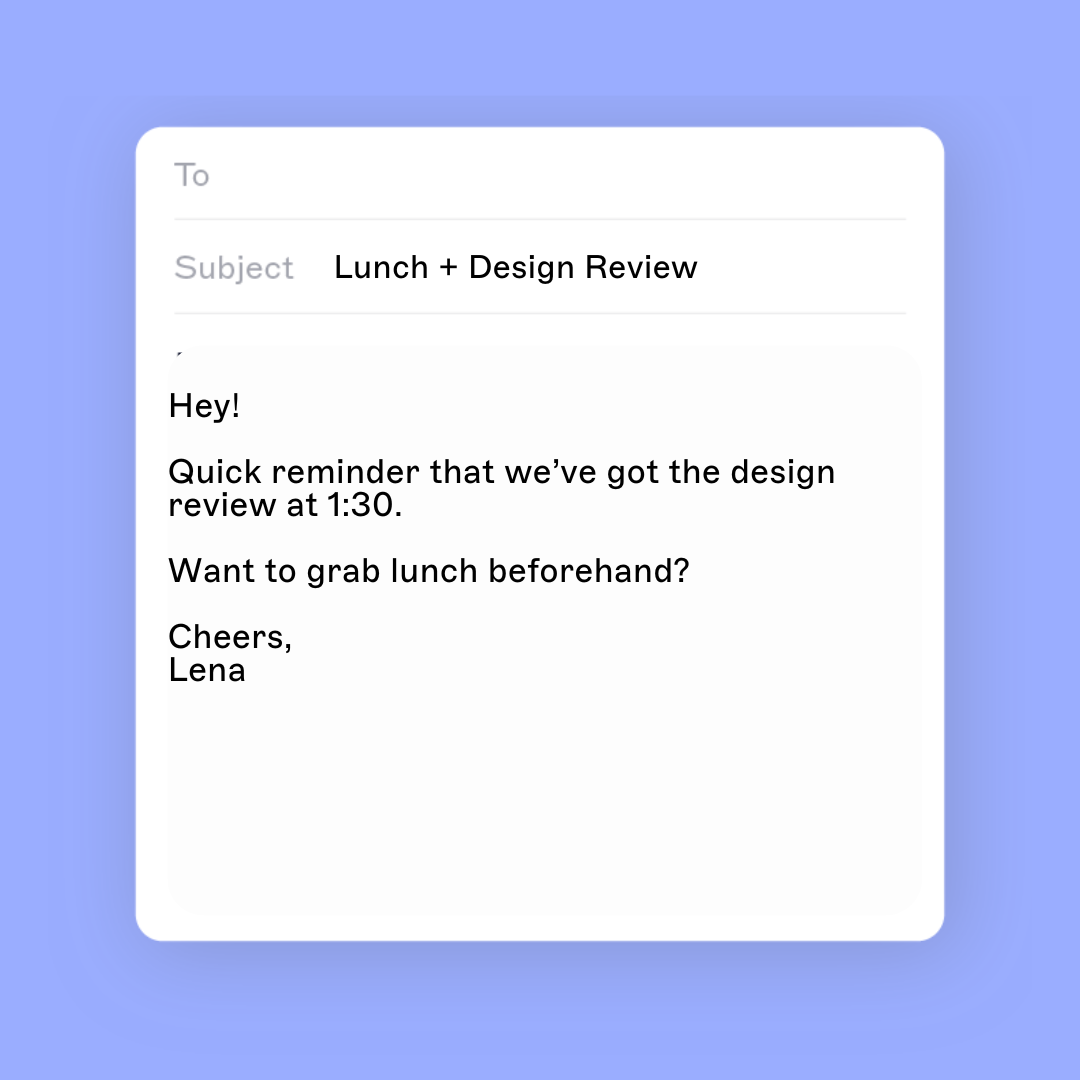
UK respondents rated "Kind regards" highest, and US respondents preferred "Thank you" and "Thanks." The surveys differ in year, wording, and options, so they can't show that UK and US readers differ. They show what each group said.
Sign-off | UK (Perkbox, 2020, 1,928 people) | US (Preply, 2022, 1,005 people) |
|---|---|---|
Kind regards | 69% rated it among the best | Listed among the most uptight closings |
Thank you, Thanks | "Thanks or thanks again" 46% rated among the best | Thank you 38% and Thanks 30% preferred |
Regards | 31% rated it among the best | Not reported |
Thanks in advance | 21% rated it among the best | 5% preferred, the lowest of the options listed |
Cheers | 26% rated it among the worst | Listed among the most casual closings |
Warmly | 31% rated it among the worst | Not reported |
No sign-off | 44% rated it among the worst | Ranked the most "savage" ending |
Tip
Always follow your email sign-off with your full name and contact information, especially in first-touch messages. Automate this with a professional email signature.
Sources: Perkbox and Preply
Should you use "Yours sincerely" or "Yours faithfully"?
In British English, use "Yours sincerely" when you've greeted the reader by name and "Yours faithfully" when you haven't. The British Council's LearnEnglish team calls this the traditional rule.
Sign-off | When to use it | Where it's used |
|---|---|---|
Yours sincerely | You've written "Dear Jane" | British English |
Yours faithfully | You've written "Dear Sir or Madam" | British English |
Sincerely yours (or Sincerely) | The American form of "Yours sincerely" | American English |
Regards, Best regards | Either case | Both |
The same team says "Best regards" and "Regards" work in either case. Reserve the traditional pair for formal letters and applications. In the Perkbox survey, 18% put "Yours faithfully" and 12% put "Sincerely" among their worst sign-offs.
In Exclaimer's research, 69% of UK adults choose email for a formal complaint, compared with 32% of US adults.
Sources: British Council LearnEnglish, Grammarly, Colorado State University's business letter guide, Perkbox, and Exclaimer's When it matters report (2026)
Kind regards or best regards?
"Kind regards" scored better in the UK survey, and the two performed alike for replies. 69% of Perkbox respondents rated "Kind regards" among the best sign-offs, and 12% put "Best" among their worst. In Boomerang's reply data, "Kind regards" got 53.9% and "Best regards" 52.9%.
Boomerang analyzed more than 350,000 threads from online community mailing lists, many from people asking for help. It measures replies, not how a sign-off reads.
Sources: Perkbox and Boomerang
Should you use "Sincerely" or "Best regards"?
"Sincerely" is the more formal of the two. Grammarly says "Regards" is less formal, which makes it useful in email, and it lists "Best regards" as a variation. The British Council lists "Yours sincerely" among its formal endings. Use "Sincerely" for formal letters and applications.
Sources: Grammarly and British Council LearnEnglish,
Which email sign-off gets the most replies?
Sign-offs that say thanks got the most replies in Boomerang's analysis. Emails with a thankful closing had a 62% response rate, against 46% for those without, a 36% relative increase.
Sign-off | Response rate |
|---|---|
Thanks in advance | 65.7% |
Thanks | 63.0% |
Thank you | 57.9% |
Cheers | 54.4% |
Kind regards | 53.9% |
Regards | 53.5% |
Best regards | 52.9% |
Best | 51.2% |
All emails in the sample | 47.5% |
These are correlations from one dataset. Reply rate and reader preference can point in different directions. "Thanks in advance" drew the most replies here and ranked last for preference among US respondents.
Sources: Boomerang and Preply
What can you say instead of "Best regards" or "Sincerely"?
Instead of "Best regards," try "Kind regards" or "Regards." Instead of "Sincerely," try "Cordially" or "Respectfully." Grammarly groups more alternatives by the sign-off they replace.
If you'd usually write | Alternatives |
|---|---|
Best regards | Kind regards, Warm regards, Kindest regards, Regards |
Best | All the best, Best wishes, Kind wishes, Take care |
Sincerely | Cordially, Respectfully, Appreciatively, With appreciation |
Thank you | Thanks, Many thanks, Thanks again, With gratitude |
Neither survey tested "Warm regards." In the Perkbox survey, 31% put "Warmly" among their worst sign-offs, so check the reader first.
Sources: Grammarly and Perkbox
Want to complete your sign-off with a professional signature? Explore these email signature examples to find pre-built designs for different role and industries.
What are some examples of email sign-offs by formality?
Common email sign-offs fall into five groups by how formal they usually read. The groups are a guide, and the relationship with the reader matters more than the label.
Group | Email sign-off examples |
|---|---|
Formal | Best, Best regards, Best wishes, Kind regards, Regards, Warm regards (Warmly, Warm wishes), Yours faithfully (Faithfully, Faithfully yours), Respectfully (Respectfully yours, Yours respectfully), Yours sincerely (Sincerely, Sincerely yours) |
Grateful or looking ahead | Many thanks (All my thanks), Speak soon, Talk soon, Thank you, Thanks in advance, That's all for now, With appreciation, With gratitude |
Semi-formal | As ever, Have a great day (Have a great week, Have a great weekend), Hope this helps, Thanks, Until next time |
Informal | Bye, Cheers, Ciao, Later, Peace (Peace out), See ya (See you), Take it easy |
Chat-style | Stay tuned, tafn, thx, ttyl, rgds |
Do your email sign-offs include legal disclaimers? Learn how to stay compliant with our email disclaimers guide, packed with tips and examples for regulated industries.
What are some funny or creative email sign-offs?
We found no data on funny sign-offs, so this is judgment. Try them with a colleague who already jokes with you, not with a new contact or a client.
"Onward,"
"Yours in spreadsheets,"
"Stay caffeinated,"
"Until the next reply-all,"
"May your inbox stay quiet,"
"Over and out,"
Readers do read tone into a sign-off. In Preply's survey, 46% of Americans said they can tell a coworker's mood from their greetings and sign-offs.
Source: Preply
Which email sign-offs should you avoid?
Avoid a sign-off that is more casual or more dated than your reader expects.
Sign-off | Why avoid it |
|---|---|
Sent from my iPhone | 51% of Americans want it or similar gone, and 65% want "Sent from my phone, please excuse typos" gone (Preply) |
Love, XOXO, x | 57% of Perkbox respondents rated "Love" among the worst sign-offs, and 65% listed kisses or "x" among the biggest faux pas |
No sign-off | 44% of Perkbox respondents rated it among the worst ways to end an email |
ttyl, thx, tafn, rgds | Chat-style shorthand that belongs in informal messages |
Yours truly | Sources disagree. The British Council lists it as formal, Grammarly lists it as one to avoid, and 24% of Perkbox respondents put it among their worst |
"Respectfully" is formal rather than wrong. Grammarly says it conveys deference, so save it for readers whose position calls for it. Preply's US respondents listed it among the most uptight closings.
Sources: Preply (2022), Perkbox (2020), Grammarly and British Council LearnEnglish.
How should you format an email sign-off?
Capitalize the first word of the sign-off, follow it with a comma, and put your name on a new line. In a multi-word sign-off such as "Kind regards," capitalize only the first word. Our email etiquette rules cover the rest of the email.
Kind regards,
Jane Smith
Sources: Grammarly and British Council LearnEnglish.
What is the difference between an email sign-off and an email signature?
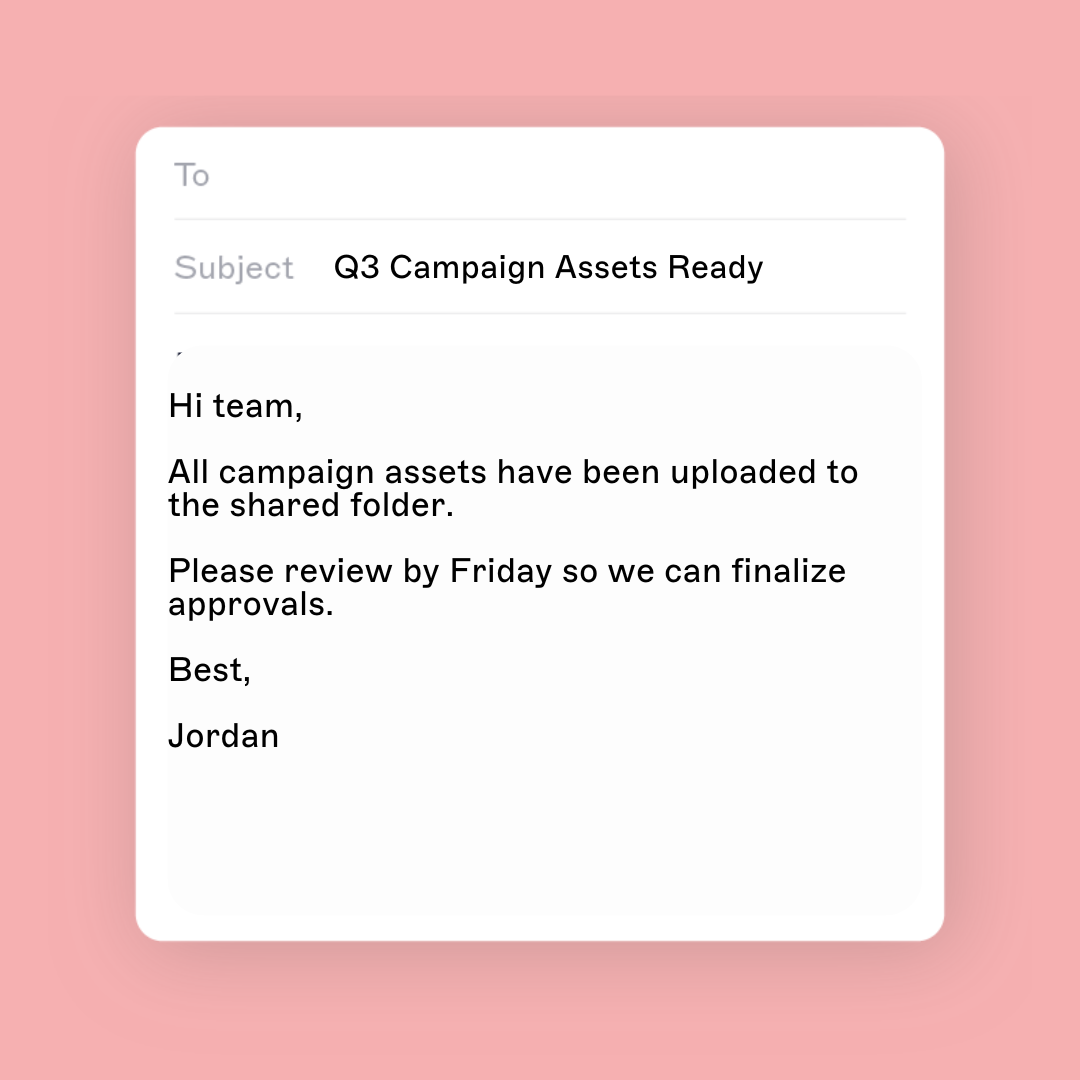
A sign-off is the closing phrase you choose for each message. An email signature is the block under it with your name, job title, and contact details.
Email sign-off | Email signature | |
|---|---|---|
What it is | A closing phrase | A block of contact details |
Example | "Kind regards," | Jane Smith, Account Manager, +1 555 0100 |
How often it changes | It can change with every email | It's usually the same on every email |
Source: Grammarly
Do readers notice the email signature?
Readers say they do. In Exclaimer's 2026 survey of 2,000 UK and US adults, 45% look for full contact details when judging whether a business email is genuine. For 23%, a professional, branded email signature is a trust signal. In the Perkbox survey, 23% named not having an email signature among the biggest email faux pas.
In Exclaimer's State of Business Email 2025 research, 92% of IT leaders agreed that consistent, well-managed email signatures build trust and professionalism. Yet 80% still rely on manual methods or user self-service. The survey covered 4,009 IT professionals and ran in April 2025 with Censuswide.
Ed Bodey, General Counsel at Exclaimer, says email signatures and disclaimers "carry mandated information in a number of jurisdictions and industries." He adds that not having them, or not being able to show you had them on particular communications, "can cause you an evidence problem."
Sources: Exclaimer's When it matters report (2026), Perkbox (2020) and Exclaimer's State of Business Email 2025 report.
Make your email sign-off count with Exclaimer
At Exclaimer, we help 80,000+ organizations send every email with a polished, compliant, and on-brand signature, no matter who sends it or from what device.
Want to see how it works? Explore our email signature solution