




Dave is a marketing expert with 15 years experience in the tech and SaaS world. He specializes in educating IT and channel audiences, with a focus on security, privacy, compliance, and marketing technology. With a talent for storytelling and a deep understanding of the industry, Dave transforms complex IT topics into clear, engaging, and impactful narratives.
U.S. email disclaimers: Laws, examples and best practices
TL;DR
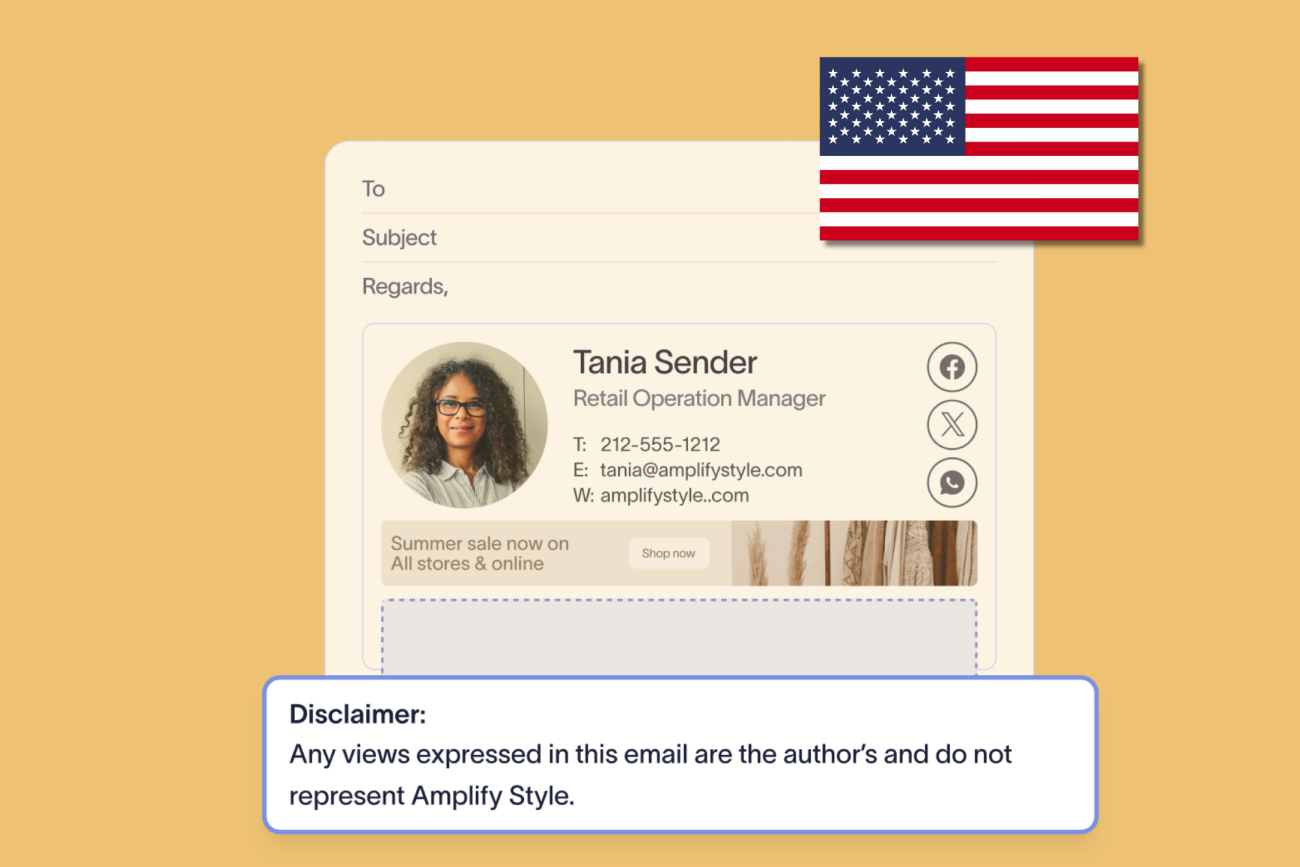
No U.S. federal or state law requires a blanket email disclaimer on every business email, but disclaimers are widely used to support risk management and internal governance
Regulated organizations use disclaimers when emails involve PHI under HIPAA, nonpublic personal information under GLBA, commercial email under CAN-SPAM, government records under FOIA, or consumer data under the CCPA/CPRA
Different industries rely on disclaimers in different ways, especially healthcare, finance, legal, and government
A good U.S. email disclaimer is short, specific, and tied to the actual risk in the message: confidentiality, PHI, financial data, public records, or marketing preferences
Disclaimers support risk management but do not replace required safeguards, privacy notices, retention policies, or legal advice
Centralized tools like Exclaimer ensure every user gets the correct disclaimer automatically, without relying on manual updates
Email remains a primary communication channel for U.S. organizations, especially when sharing sensitive or regulated information. Because of this, compliance officers and IT teams across the country add an email disclaimer to clarify confidentiality, reduce risk, and set expectations for how the message should be handled.
Unlike some regions, the United States doesn't have a single law that requires a general email disclaimer. But several federal and state regulations — along with industry-specific governance requirements — make it important to use clear, consistent wording in business email. This helps organizations reduce accidental disclosure, support compliance workflows, and protect sensitive data.
This guide explains how email disclaimers are used across the United States, how they relate to key regulations, and what U.S. organizations should include to stay consistent and reduce legal exposure.
Are email disclaimers legally required in the United States?
In short, no. There is no federal or state law in the United States that requires a general email disclaimer. The CAN-SPAM Act (15 U.S.C. § 7701 et seq.) regulates commercial email content — requiring accurate sender identification, a physical postal address, and a functioning opt-out mechanism — but it does not require a generic confidentiality disclaimer. Businesses aren't are not legally obligated to add one to everyday email communication.
Even so, many U.S. organizations use disclaimers as a practical way to:
Reduce the risk of accidental disclosure
Clarify confidentiality
Reinforce how sensitive information should be handled
Support internal policies around data protection
Guide recipients if an email is sent to the wrong person
In regulated industries such as healthcare, financial services, legal, and government, email disclaimers are widely used. They help create consistency in how organizations communicate and provide an additional reminder to treat certain information carefully.
When U.S. organizations use email disclaimers
Even though email disclaimers aren't legally required in the United States, many organizations use them as part of their communication standards. They provide clarity around how information should be handled and set expectations for both employees and external recipients. In practice, U.S. businesses typically add an email disclaimer when:
1. Sharing sensitive or regulated information
Teams working with financial data, health information, or internal documents often include a short notice to reinforce that the content shouldn't be shared outside its intended audience.
2. Reducing risk from misdirected emails
Accidental sends are common. A quick instruction for unintended recipients, such as deleting the message, helps demonstrate that the organization takes responsible steps to limit exposure.
3. Clarifying confidentiality or privilege
Legal teams, government bodies, and professional services firms frequently add disclaimers to show that certain emails should be treated as confidential or privileged.
4. Supporting internal governance policies
Large organizations use disclaimers to keep communication consistent across departments. This helps avoid one-off variations that could open the door to ambiguity or misuse.
5. Operating across multiple states with varying privacy expectations
While no U.S. state requires a disclaimer, recipients in privacy-forward states (like California or Colorado) expect clear communication around how personal information is handled.
6. Communicating with customers or the public
Disclaimers can supplement customer-facing messages by pointing recipients to relevant policies. Examples include privacy notices or ways to manage communication preferences.
In short, U.S. organizations rely on disclaimers not because the law demands them, but because they bring clarity, reduce risk, and make communication more consistent.
Which U.S laws affect email disclaimers?
Because there's no single legal standard in the United States, the content of an email disclaimer depends on the type of information being shared and who is receiving it. The table below summarizes the most common U.S. laws that affect email communication, whether they require a disclaimer, and what each actually requires.
Law / Rule | Applies to | Requires email disclaimer? | What it actually requires | Useful disclaimer type |
|---|---|---|---|---|
CAN-SPAM Act, 15 U.S.C. § 7701 | Commercial email senders | No | Accurate sender ID, physical postal address, functioning opt-out | Marketing or preferences footer |
HIPAA, 45 C.F.R. Parts 160 & 164 | Covered entities and business associates | No | PHI safeguards: administrative, physical, and technical controls | PHI confidentiality notice |
GLBA, 15 U.S.C. §§ 6801–6809 | Financial institutions | No | Safeguarding nonpublic personal information; required privacy notices | Financial privacy notice |
FISMA | Federal agencies and contractors | No | Risk management, secure data handling, information-security controls | Sensitive government information notice |
FOIA, 5 U.S.C. § 552 | Federal agencies | No | Public access to agency records, subject to exemptions | Public-records notice |
FRCP, Rules 26, 34, 37(e) | Litigation parties | No | ESI discovery scope, production, and preservation obligations | Privilege or confidentiality notice |
CCPA/CPRA, Cal. Civ. Code § 1798.100 | Covered California businesses | No | Privacy notices; consumer rights: access, deletion, correction, opt-out | Privacy-policy link with rights |
Texas Public Information Act, Tex. Gov't Code ch. 552 | Texas state and local government bodies | No | Public access to government records, subject to exemptions | Public-records notice |
SOX, Pub. L. No. 107-204 | Public companies | No | Financial reporting integrity; internal controls (§§ 302, 404) | Confidential financial-information notice |
SEC Rule 17a-4, 17 CFR § 240.17a-4 | Broker-dealers | No | Electronic records preservation (3 years; first 2 accessible) | Preserved-record clause |
FINRA Rule 2210 | FINRA member firms | No | Fair, balanced communications; firm identification; principal approval for retail comms | Member firm identification |
Federal Information Security Management Act (FISMA)
The Federal Information Security Management Act (FISMA) sets the security standards federal agencies and their partners must follow when handling sensitive government data. Its core focus is risk management, secure data handling, and maintaining strong controls across all information systems. This includes email.
FISMA doesn't require a specific email disclaimer. But many government agencies use disclaimers as part of their wider information-security policies. These notices help clarify confidentiality, reduce the risk of accidental disclosure, and reinforce that messages may contain regulated or sensitive information.
For teams operating under FISMA, the priority is clear: protect data, document controls, and maintain secure communication practices. Adding a consistent email disclaimer supports these internal policies and helps ensure staff treat email content appropriately.
Use when: Email is sent or received by a federal agency or contractor and may contain sensitive government information.
Legal status: FISMA doesn't require this disclaimer. It does not replace the risk management, access control, and incident-response requirements FISMA imposes.
FISMA email disclaimer (example)
This email may contain sensitive information related to government operations. If you are not the intended recipient, please delete the message and notify the sender immediately. Do not share or distribute its contents without authorization. |
Useful FISMA resources:
Federal Rules of Civil Procedure (FRCP)
The Federal Rules of Civil Procedure (FRCP) outline how electronic information must be managed and produced during civil litigation in the United States. The 2006 amendments brought email and other electronic records directly into scope, making eDiscovery a standard part of legal proceedings.
FRCP doesn't require an email disclaimer. Rules 26 (discovery scope and proportionality), 34 (production of electronically stored information), and 37(e) (sanctions for failure to preserve ESI) govern what organizations must be able to produce and preserve in litigation, not what their email footers say. Many organizations use email disclaimers to reinforce that messages may contain privileged or confidential information and should be handled accordingly. This helps reduce the risk of misuse or unapproved distribution, which are issues that often become relevant in discovery.
For U.S. businesses, FRCP compliance depends on good data management, not just disclaimer text. A clear, consistent email disclaimer can support internal governance, but it doesn't replace the need for strong retention and eDiscovery processes.
Use when: Email may contain privileged, confidential, or legally sensitive information in an organization subject to civil litigation.
Legal status: FRCP does not require this disclaimer. It does not establish privilege, prevent disclosure in discovery, or substitute for a proper litigation hold.
FRCP email disclaimer (example)
This email may contain internal or privileged information. Please handle it with care, as email communication may be subject to review or disclosure during legal proceedings. If you received this in error, delete it and inform the sender. |
Freedom of Information Act (FOIA)
The Freedom of Information Act (FOIA), 5 U.S.C. § 552, gives the public the right to access federal government records. Because email is a primary communication channel for agencies, messages can become part of the public record if they fall within the scope of a FOIA request.
Many agencies use FOIA email disclaimers to remind recipients that emails may contain sensitive or confidential information, and to encourage proper handling if a message is misdirected. This helps reduce the risk of accidental disclosure before a request is formally reviewed.
For teams handling FOIA-related correspondence, a consistent disclaimer supports good communication hygiene and reinforces that messages may be subject to public disclosure laws. It's a straightforward way to reduce confusion and ensure recipients understand the sensitivity of the information they're receiving.
Use when: Email is sent or received by a federal government agency and may be subject to FOIA disclosure.
Legal status: FOIA (5 U.S.C. § 552) does not require this disclaimer. It does not exempt a record from disclosure or replace formal exemption analysis.
FOIA email disclaimer (example)
This email may include information that is subject to the Freedom of Information Act, 5 U.S.C. § 552. If you are not the intended recipient, delete the message and notify the sender. Please avoid sharing or forwarding the contents without approval. |
Useful FOIA resources:
Gramm-Leach-Bliley Act (GLBA)
The Gramm-Leach-Bliley Act (GLBA), 15 U.S.C. §§ 6801–6809, sets strict requirements for how U.S. financial institutions handle consumer data. Banks, credit unions, insurance companies, and other financial service providers must protect nonpublic personal information and give customers clear privacy notices.
GLBA doesn't mandate the use of email disclaimers. However, many organizations include them as part of their broader privacy and communication policies. A well-written disclaimer helps reinforce that emails may contain sensitive financial information and shouldn't be shared or forwarded without care. It also reminds customers not to include account numbers or other personal data in unsecured email replies.
For U.S. financial institutions, the value of an email disclaimer supports good data-handling practices and helps reduce the risk of accidental disclosure. It's a practical addition to a GLBA compliance program, even though it isn't a legal requirement.
Use when: Email may contain nonpublic personal information shared with or by a financial institution.
Legal status: GLBA (15 U.S.C. §§ 6801–6809) does not mandate this disclaimer. It does not replace required privacy notices, safeguards, or FTC Safeguards Rule compliance.
GLBA email disclaimer (example)
This message may contain nonpublic personal information protected under the Gramm-Leach-Bliley Act (15 U.S.C. §§ 6801–6809) and company policy. If you are not the intended recipient, do not read, copy, forward, or disclose this message. Notify the sender immediately and delete all copies. Do not send account numbers, Social Security numbers, or other sensitive financial information by unsecured email. |
Useful GLBA resources:
- Gramm-Leach-Bliley Act guidance from the Bureau of Consumer Protection
- Full Gramm-Leach-Bliley Act Text (PDF)
Health Insurance Portability & Accountability Act (HIPAA)
The Health Insurance Portability and Accountability Act (HIPAA) sets the national standards for protecting patient health information in the United States. HIPAA's Privacy, Security, and Breach Notification Rules are codified at 45 C.F.R. Parts 160 and 164. Any organization that creates, receives, transmits, or stores protected health information (PHI) must follow strict rules to keep that data secure.
This law strongly recommends that healthcare organizations in the U.S. use email disclaimers to emphasize patient confidentiality in all email communications. While HIPAA email disclaimers aren't legally binding, they play an important role in patient communication and demonstrate the organization’s commitment to HIPAA compliance.
Healthcare organizations often include a disclaimer to:
Remind recipients that email is not a fully secure communication channel
Highlight that the message may contain confidential health information
Instruct unintended recipients to report or delete the message
These notices don't create HIPAA compliance, but they help reinforce good communication practices and set expectations for anyone receiving the email.
"Healthcare organizations often treat email disclaimers as a formality. In a HIPAA context, they do real work: they set the expectation that protected health information must not be shared, and they document the organization's intent to handle PHI responsibly from the moment a message is sent. A disclaimer is not a substitute for encryption or access controls, but it is a clear, consistent signal that the information is sensitive and subject to strict handling requirements." Karl Bagci, Director of IT and Information Security, Exclaimer
Use when: Email may contain PHI or other health-related confidential information.
Legal status: HIPAA (45 C.F.R. Parts 160 and 164) does not expressly require this disclaimer. It does not replace encryption decisions, access controls, risk analysis, or breach-response obligations under 45 C.F.R. § 164.306.
HIPAA email disclaimer (example)
This message may contain Protected Health Information (PHI) regulated under HIPAA, 45 C.F.R. Parts 160 and 164. If you are not the intended recipient, do not read, copy, forward, or disclose this message. Notify the sender immediately and delete all copies. Standard email may not be a fully secure transmission method; do not send PHI by email unless authorized by organizational policy or transmitted through an approved secure channel. |
Texas Public Information Act
The Texas Public Information Act, Tex. Gov't Code ch. 552, gives individuals the right to access public records held by state and local government bodies. Because email is a common communication tool across agencies, many messages can be subject to disclosure if they fall within the scope of a request.
The law doesn't require the use of email disclaimers. However, Texas agencies often include them to signal that a message may contain sensitive or confidential information, and to guide proper handling if it's sent to the wrong person. This helps reduce the risk of accidental exposure before a record is formally reviewed.
For teams operating under the Texas Public Information Act, a consistent email disclaimer supports good communication hygiene and reinforces that data must be handled carefully — especially when it relates to individuals, government operations, or protected information.
Use when: Email is sent or received by a Texas state or local government body and may qualify as a public record.
Legal status: The Texas Public Information Act (Tex. Gov't Code ch. 552) does not require this disclaimer. It does not exempt a record from disclosure or substitute for a formal Attorney General ruling on applicable exemptions.
Texas Public Information Act-aware disclaimer (example)
This email may contain information that is subject to public disclosure under the Texas Public Information Act, Tex. Gov't Code ch. 552. If you received this message in error, delete it and let the sender know. Do not share or forward the contents without approval. |
California Consumer Privacy Act (CCPA)
The California Consumer Privacy Act (CCPA), as amended by the California Privacy Rights Act (CPRA), Cal. Civ. Code § 1798.100 et seq., gives California residents more control over how businesses collect, use, and share their personal information. It requires clear explanation of data practices and gives consumers rights such as access, deletion, correction, and the ability to opt out of the sale or sharing of their data.
CCPA doesn’t require organizations to include an email disclaimer. Compliance depends on transparent privacy notices, internal controls, and honoring consumer rights. Even so, many U.S. businesses add a short disclaimer to reinforce their privacy practices and remind recipients how their information is handled.
A typical CCPA/CPRA-aligned email footer might:
Point recipients to the company's privacy notice
Identify how to exercise consumer rights: access, deletion, correction, and opt-out
Explain how to manage data or communication preferences
These disclaimers aren't a legal requirement, but they support transparency and help set expectations for recipients. This is especially important for businesses operating across state lines.
Use when: Email is sent by an organization covered by the CCPA/CPRA and may involve the collection or use of California residents' personal information.
Legal status: The CCPA/CPRA (Cal. Civ. Code § 1798.100 et seq.) does not require a disclaimer. It does not replace the required Privacy Notice or the processes for honoring consumer rights.
CCPA/CPRA email disclaimer (example)
California residents: For details about how [Company Name] collects, uses, shares, and retains personal information, and to exercise rights under the CCPA/CPRA — including access, deletion, correction, and opt-out of sale or sharing — visit our Privacy Notice at [URL] or submit a request at [URL]. To manage email preferences or unsubscribe, visit [URL]. |
Sarbanes-Oxley (SOX)
The Sarbanes-Oxley Act (SOX), formally Pub. L. No. 107-204, was introduced to improve corporate accountability and protect investors after major financial scandals. Its Sections 302 and 404 focus on financial reporting integrity, executive certifications, and internal-control requirements.
While SOX doesn’t require email disclaimers, many U.S. organizations use them to reinforce good communication practices — especially when email is used to share financial information or internal updates.
A SOX-aligned email disclaimer typically helps to:
Clarify that the message may contain confidential or company-sensitive information
Indicate that the email is an official communication from the organization
State that the content should not be forwarded or shared without authorization
Remind employees to follow internal policies when handling financial data
These notices don't create SOX compliance, but they help reduce the risk of accidental disclosure and support a culture of accountability — both of which are central to SOX's intent.
Use when: Email contains confidential financial information, internal-control documentation, or material nonpublic information at a public company.
Legal status: SOX (Pub. L. No. 107-204) does not mandate this disclaimer. It does not substitute for required internal controls, executive certifications, or audit procedures under Sections 302 and 404.
SOX email disclaimer (example)
This email and any attachments may contain confidential financial information, internal-control documentation, or material nonpublic information subject to [Company Name] policy and applicable securities laws. Do not copy, forward, distribute, or rely on this message without authorization. If you are not the intended recipient, notify [[email protected]] and permanently delete all copies. |
Securities and Exchange Commission (SEC)
SEC Rule 17a-4 (17 CFR § 240.17a-4) requires broker-dealers to preserve outgoing electronic communications for three years, with the first two years kept in an easily accessible place. Registered investment advisers (RIAs) operate under a separate but parallel obligation: Rule 204-2 of the Investment Advisers Act of 1940 requires RIAs to retain written communications for five years, with the first two years kept at an appropriate office of the adviser.
Rule 17a-4 is a recordkeeping rule, not a content rule. It does not mandate specific disclaimer language. What it does require is that a firm's communications are consistent with its documented compliance procedures and that the disclaimer text does not contradict the firm's recordkeeping or supervision practices.
For RIAs, Section 206 of the Investment Advisers Act of 1940 establishes fiduciary obligations that affect how outbound communications are framed. When email content crosses into advertising — for example, by including performance claims or testimonials — the SEC's Marketing Rule (Rule 206(4)-1) applies additional requirements around substantiation and fair presentation.
The table below maps each rule to its implication for disclaimer language. All sample text is provided for review by counsel. It requires CCO approval before use and should not be treated as Exclaimer-recommended compliant text.
Rule | Who it applies to | Clause implication | Sample language for review by counsel |
|---|---|---|---|
SEC Rule 17a-4 (17 CFR § 240.17a-4) | Broker-dealers | Preserved-record clause | "This message and any attachments are part of [Firm]'s preserved business records in accordance with applicable SEC recordkeeping requirements." |
Investment Advisers Act of 1940, § 206 | RIAs | Fiduciary-disclosure clause | "Nothing in this communication constitutes investment advice. [Firm] is a registered investment adviser and acts in the best interest of its clients in accordance with its fiduciary obligations under the Investment Advisers Act of 1940." |
SEC Marketing Rule (Rule 206(4)-1) | RIAs | No-promissory-claims clause | "Past performance is not indicative of future results. This communication does not constitute an offer to buy or sell any security." |
Useful SEC resources:
- SEC Rule 17a-4 final rule
- 17 CFR § 240.17a-4 (eCFR current text)
- Investment Advisers Act of 1940
- SEC Marketing Rule (Rule 206(4)-1) staff guidance
Financial Industry Regulatory Authority (FINRA)
FINRA Rule 2210 (Communications with the Public) governs the content and supervision of all communications sent by member firms, including outbound email. Three requirements are central to how Rule 2210 applies in the email context: communications must be fair, balanced, and not misleading; they must be supervised and, depending on their category, reviewed before use; and they must identify the member firm.
For broker-dealers, those requirements translate into specific elements the email disclaimer should address:
The firm's registered legal name must appear in the email or its footer
Registered representatives must be identified as such, where relevant to the communication
No exaggerated or unwarranted claims may appear in the communication or its disclaimer
Language that implies a guarantee of returns or investment outcomes is not permitted
Retail communications (those distributed to more than 25 retail investors within any 30 calendar-day period) require approval from a registered principal before use. Firms must document that approval for each version of the disclaimer they deploy.
FINRA Rule 2266 (SIPC Information) separately requires member firms to disclose SIPC membership to customers at account opening and at least annually in writing. As a result, including "Member SIPC" in email footers has become standard practice across the broker-dealer industry. Firms should confirm the scope of this requirement with their compliance team.
FINRA also expects firms to have documented supervision procedures for electronic communications. The FINRA cybersecurity and electronic communications guidance sets out those expectations in detail.
Sample compliant disclaimer for a registered representative
The following is provided as illustrative language only. It requires review and approval by the firm's CCO and registered principal before use. It should not be treated as Exclaimer-recommended compliant text.
This email is sent by [Legal Entity Name], a member of FINRA and SIPC. It is intended solely for the named recipient and does not constitute investment advice. No guarantee of investment returns is expressed or implied. If you received this email in error, please delete it and notify the sender. This communication is a preserved business record subject to applicable SEC and FINRA recordkeeping requirements. |
Useful FINRA resources:
- FINRA Rule 2210 (Communications with the Public)
- FINRA Rule 2266 (SIPC Information)
- FINRA cybersecurity and electronic communications guidance
State privacy laws and email communication
Several U.S. states now have their own consumer privacy laws, each designed to give residents more control over their personal information. These laws focus on transparency, data rights, and responsible handling of personal information.
Some examples include:
Virginia Consumer Data Protection Act (VCDPA)
Colorado Privacy Act (CPA)
Connecticut Data Privacy Act (CTDPA)
Utah Consumer Privacy Act (UCPA)
Oregon Consumer Privacy Act (OCPA)
None of these state laws require organizations to include an email disclaimer. Compliance relies on clear privacy notices, proper data governance, and honoring consumer rights. Even so, many businesses add short email notices to reinforce transparency and direct recipients to relevant policies.
Essential elements of an email disclaimer for investment firms
The checklist below covers the core clauses a compliance or legal team should consider for an investment firm's email disclaimer. Each item identifies the regulatory driver. All final language requires CCO review and approval before deployment.
This checklist does not constitute legal advice, and firms should confirm requirements with qualified securities counsel.
Confidentiality clause — Protects privileged or sensitive material from unauthorized disclosure. Applies under common-law principles and applicable state privacy regimes.
No-investment-advice clause — Limits liability where a casual statement could be read as regulated investment advice. Driven by the fiduciary obligations of the Investment Advisers Act of 1940, Section 206 for RIAs, and the suitability and best-interest obligations of broker-dealers.
Regulatory body reference — Identifies the relevant regulator and establishes the firm's regulatory status. Driven by SEC registration requirements and, for broker-dealers, the firm identification requirement of FINRA Rule 2210.
Firm identification — Names the registered legal entity and, where appropriate, the CRD or IARD number. Required for broker-dealers under FINRA Rule 2210's firm identification standard.
SIPC membership statement — Confirms SIPC membership for eligible broker-dealers. While FINRA Rule 2266 requires SIPC disclosure at account opening and annually, inclusion in email footers is standard industry practice across member firms.
Supervision reference — Points to a named supervisor or compliance email address, supporting documented electronic communications oversight under FINRA supervision rules.
Recordkeeping note — Signals that the message is a preserved business record. Broker-dealers: supports compliance with SEC Rule 17a-4 (three-year retention). RIAs: supports compliance with Rule 204-2 under the Investment Advisers Act (five-year retention).
How Exclaimer helps U.S. organizations manage email disclaimers
Email disclaimers only work when they're consistent. Relying on employees to add or maintain them leads to mistakes, outdated text, and uneven formatting across teams. Exclaimer removes that burden by managing disclaimers centrally and applying the right version to every outgoing email — no manual updates required.
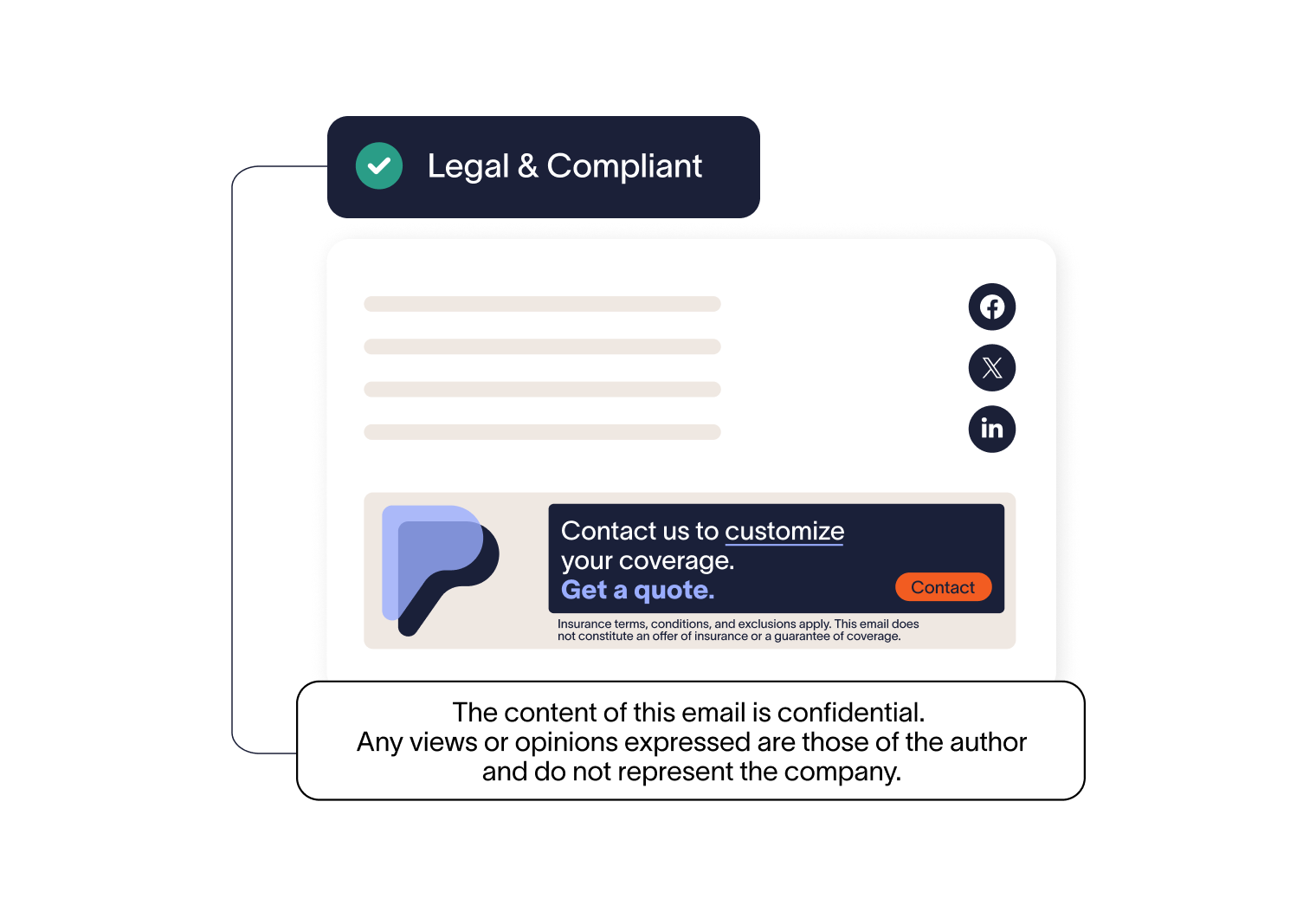 More than 80,000 organizations use Exclaimer to manage this centrally, across Microsoft 365, Google Workspace, and Microsoft Exchange.
With Exclaimer, you can:
Standardize disclaimers across all users to ensure every email includes the correct wording
Create variations for different teams or regions while keeping full administrative control
Update language instantly when policies change, without relying on staff to make edits
Keep branding and formatting consistent using a single, centrally managed design
Support governance and risk reduction by ensuring the right message is applied every time
Exclaimer doesn’t replace legal or compliance frameworks, but it helps organizations stay consistent, reduce avoidable errors, and maintain a professional communication standard
If you want a simpler way to manage disclaimers across your organization, you can try Exclaimer and see how centralized control makes email governance easier. Start a free trial today.