



Dave is a marketing expert with 15 years experience in the tech and SaaS world. He specializes in educating IT and channel audiences, with a focus on security, privacy, compliance, and marketing technology. With a talent for storytelling and a deep understanding of the industry, Dave transforms complex IT topics into clear, engaging, and impactful narratives.
What is an email disclaimer? How to stay compliant with every email you send

TL;DR
Email disclaimers are short legal statements added to the bottom of emails to reduce liability, support compliance, and protect sensitive information.
Key benefits: Help organizations meet GDPR, HIPAA, and industry regulations; limit legal risk; enforce confidentiality; and clarify that emails are not binding contracts.
Use cases: External communications in legal, finance, healthcare, insurance, and international businesses. Also useful for internal emails with sensitive content.
New in 2026: Since August 2, 2026, the EU AI Act's Article 50 adds a separate disclosure duty when a recipient is interacting with AI. Using AI to draft or send a message doesn't remove your existing disclaimer obligations either.
Best practices: Tailor disclaimers by region or department, keep them concise, use plain text, avoid repetition in threads, and manage them centrally using tools like Exclaimer.
The importance of email disclaimers
Email disclaimers are easy to overlook, but they reduce legal risk, help meet regulations like GDPR or HIPAA, and protect sensitive data in regulated industries like healthcare, finance, law, and insurance.
In this guide, we'll discuss the different types of email disclaimers, their purpose, and how to create an effective disclaimer that supports legal compliance.
Simplify email disclaimer creation
Skip the guesswork and create a clear, usable email disclaimer in minutes with Exclaimer’s generator.
What is an email disclaimer?
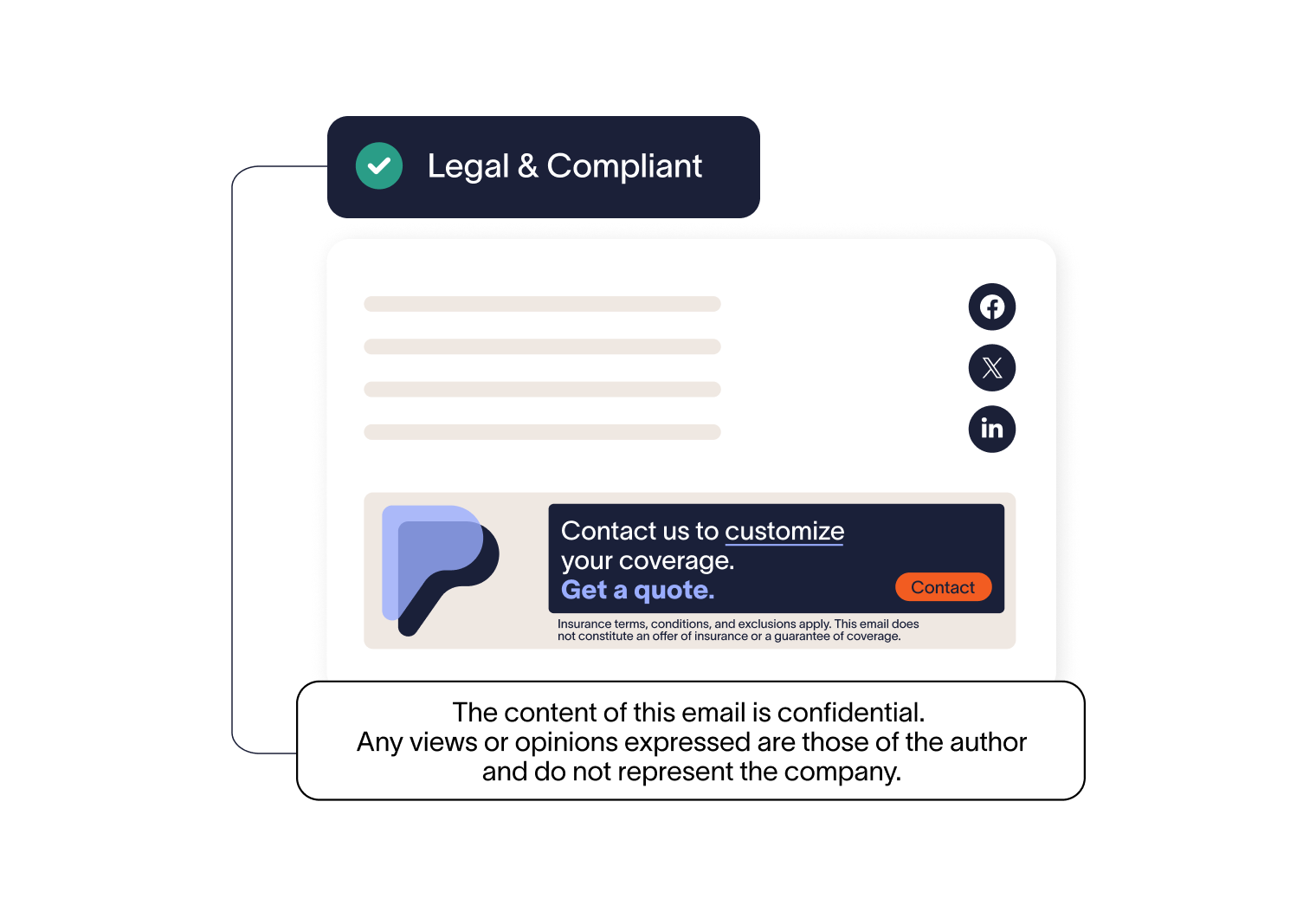
An email disclaimer is a statement typically placed at the end of an email, that communicates important legal, confidentiality, or liability information to the recipient. It's a block of text added to an outgoing business email, and usually appears as a separate element below a professional email signature.
 These disclaimers often include a combination of:
The company’s name and registered office address
Legal registration details
A confidentiality statement
A non-liability clause
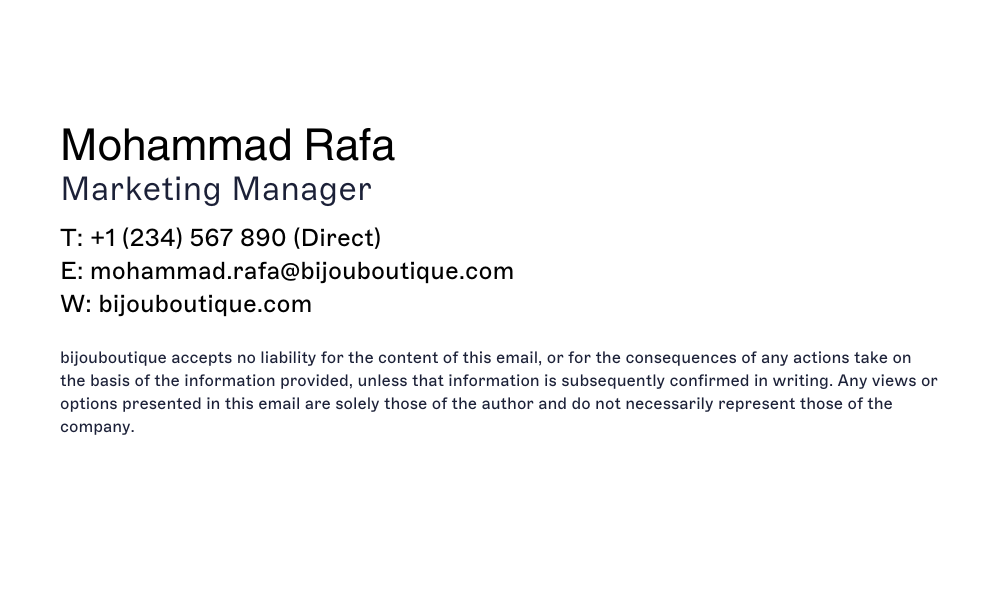
Example:
[COMPANY] accepts no liability for the content of this email or for the consequences of any actions taken on the basis of the information provided, unless that information is subsequently confirmed in writing. Any views or opinions presented in this email are solely those of the author and do not necessarily represent those of the company.
Is an email disclaimer necessary?
Yes, while not always legally required, email disclaimers are strongly recommended for organizations that want to reduce legal risk, protect sensitive information, and support compliance with privacy laws such as GDPR, CCPA, and HIPAA.
 Email communication is increasingly subject to global regulations due to growing concerns about data breaches, cyberattacks, and privacy violations.
While no law explicitly mandates a disclaimer in every country, using one is often seen as a best practice for due diligence, especially in regulated industries.
Even if not required by law, email disclaimers can:
Reduce legal exposure
Promote transparency and professionalism
Support compliance efforts (e.g., GDPR, HIPAA, CCPA, CAN-SPAM)
Build trust with recipients and stakeholders
Disclaimers may not prevent all legal issues, but they can strengthen your legal position and show due diligence.
That gap between "we have a policy" and "we can prove it" isn't hypothetical. In Exclaimer's 2025 State of Business Email study of 4,009 IT professionals, 94% said they felt confident in their organization's compliance posture, but only 47% said they felt very confident once asked more precisely, and fewer than a third (33%) had implemented basic email authentication (DMARC, DKIM, or SPF). Confidence and proof aren't the same thing, and most organizations are running on the first without the second.
“Disclaimers are part of the broader compliance toolkit, alongside encryption, DLP and retention policies. They don't replace those, they show intent. When regulators audit your communications, they're not just checking you secured the data, they're looking at what you told people about it.”
What is the role of email disclaimers?
Email disclaimers act as a legal safety net. They don’t guarantee full protection, but they can help reduce liability, support regulatory compliance, and clarify sender intent.
 While some critics argue that disclaimers lack legal weight in court, they remain a widely adopted best practice across industries and regions.
When clearly written and correctly applied, an email disclaimer can cover you in the following areas:
1. Legal protection
Email disclaimers help safeguard businesses from potential legal action, reducing risks associated with emails sent by employees.
2. Regulatory compliance
In many industries and countries, email disclaimers are required by law. For example, the GDPR mandates informing recipients about their rights regarding personal data.
3. Transparency and trust
Including disclaimers in emails promotes transparency by clearly stating terms, conditions, and usage policies, building trust with recipients.
4. Limiting liability
Protect your business from liability related to inappropriate content, such as defamatory statements or copyright infringement.
5. Confidentiality protection
Email disclaimers address confidentiality breaches and help enforce data privacy.
6. No legal agreements
They clarify that emails do not constitute legally binding contracts unless explicitly stated.
7. Negligent advice disclaimer
Disclaimers protect your business from damages caused by unintentional or negligent advice shared by employees.
8. Virus warnings
Warn email recipients about the potential risk of viruses or malware being transmitted via email attachments.
Tip
Tailor the language of your disclaimer depending on jurisdiction, industry, and audience. Use personalization (like sender name or department) where required by law.
"Email disclaimers can be an underrated area. They look small, and we're all so used to seeing them at the bottom of a message, but they carry mandated information in a number of jurisdictions and industries, and that information is often determined by regulatory requirements. Not having them, or not being able to show you had them on particular communications, can cause you an evidence problem."

A disclaimer's real value is evidentiary. Applied the same way on every email, to every recipient, it shows your organization followed its own policy. The two problems that undermine that evidence are the same ones IT and legal run into constantly: disclaimers that vary by department or get typed each time differently, and disclaimers that quietly stop appearing because someone forgot to update a rule after a rebrand or a new hire. A disclaimer that isn't there, or isn't provably consistent, is a harder gap to explain in an audit than most legal teams expect.
What are the main types of email disclaimers?
There are various types of email disclaimer examples that serve different purposes, such as ensuring legal compliance, protecting confidential information, or clarifying the sender’s intentions. Each type of disclaimer is tailored to specific needs, making it important to choose the right one for your emails.
1. Confidentiality disclaimer
This type of email disclaimer is used when dealing with sensitive information or client communication.
Example:
This message is intended solely for the use of the individual or entity to whom it is addressed and may contain confidential or legally privileged information.
2. Virus transmission disclaimer
This legal disclaimer is used to protect the sender from liability if an email contains a virus or malware.
Example:
While we have taken precautions to ensure this email is free of viruses, we recommend that you scan all attachments for malware. We are not responsible for any damage caused by viruses transmitted via email.
3. Liability disclaimer
This type of email disclaimer is used to limit liability for any unintended consequences that may arise from acting upon information provided in an email.
Example:
The information provided in this email is for informational purposes only. [Your Company Name] accepts no liability for any errors or omissions in the content of this email or for any actions taken based on it.
4. Non-binding disclaimer
This disclaimer is used to clarify that the content of an email does not represent a formal agreement.
Example:
This email does not constitute a binding agreement and is for informational purposes only. Any commitments or representations are subject to a formal written contract.
5. Contract disclaimer
This email disclaimer is used in sales or procurement to avoid accidental contract formation.
Example:
No employee or agent is authorized to conclude any binding agreement on behalf of [Your Company Name] with another party by email without express written confirmation by an authorized representative.
6. Privilege disclaimer
Legal professionals often use an email disclaimer of this type to protect attorney-client communications and assert legal privilege.
Example:
This email may contain privileged attorney-client information. If you are not the intended recipient, please delete this email and notify the sender immediately. Unauthorized use or dissemination of this communication is prohibited.
Tip
Use different disclaimers for different departments (e.g., Legal, Sales, Finance) keep each one relevant and compliant.
What are the common issues with email disclaimers?
While email disclaimers are widely used, they’re not without challenges. Their impact varies based on formatting, placement, and legal jurisdiction. Below are some of the most common issues businesses face:

1. Recipient engagement
Due to their routine presence, many recipients tend to overlook or ignore email disclaimer content. This can diminish their intended impact.
2. Impact on email readability
Lengthy legal disclaimers can clutter email threads. This can make conversations harder to follow, potentially obscuring essential information.
3. Professional appearance
Overly verbose disclaimer text can appear unprofessional or overwhelming. This can potentially affect the credibility of the sender.
4. Technical limitations
Certain email clients, such as Gmail and Outlook Web App (OWA), impose character limits that can truncate lengthy email signature disclaimers. This leads to incomplete or fragmented messages.
5. Legal limitations
While confidential email disclaimers aim to limit liability, they can't cover all forms of legal responsibility. Their enforceability varies and may not provide absolute protection.
Courts don't need much to find a binding agreement, which is exactly why the wording in your email disclaimer and signature matters. In September 2025, the Court of Appeal in DAZN Limited v Coupang Corp. [2025] EWCA Civ 1083 upheld a ruling that a $1.7 million broadcasting-rights deal for the FIFA Club World Cup had been struck through a handful of emails and WhatsApp messages, months before any formal contract was signed. The court's reasoning was direct: the absence of "subject to contract" wording counted against the party that later wanted to walk away.
If an email exchange shouldn't bind you, the case law says you need to say so. The same principle extends to what's sitting in your footer by default. In Neocleous v Rees [2019] EWHC 2462 (Ch), a routine, auto-generated email signature, just a name, job title, and firm details, was found sufficient to satisfy the legal signature requirement for a UK land settlement.
Neither case is a story about disclaimers failing. Both are about what happens when the right wording isn't there.
6. Jurisdictional variances
The legal standing of email disclaimers differs across jurisdictions. In some regions, they may be deemed unenforceable or unnecessary.
Tip
Keep disclaimers short, readable, and relevant. Use legal review to confirm jurisdictional accuracy and avoid unnecessary risks.
Do AI-generated emails still need a disclaimer?
Your existing disclaimer obligations don't disappear just because AI helped write the message. Separately, the EU AI Act's Article 50 adds a new, more settled duty of its own: telling someone when they're interacting with an AI system directly, like a chatbot, rather than a person.
Article 50 of the EU AI Act became enforceable on August 2, 2026. Its clearest, most settled application is disclosure when someone is interacting with an AI system directly, such as a chatbot or voice assistant, unless that's already obvious from context. A separate, narrower requirement, machine-readable marking of AI-generated content, has a grace period to December 2, 2026 for systems already on the market.
How far that reaches into everyday AI-assisted email, an employee using an AI tool to help draft a message a human still reviews and sends, is a genuinely less settled question, and one reasonable legal teams could read differently.
That's exactly why any AI-disclosure language a business adds should get its own legal sign-off rather than being copied from this guide.
"Mandatory disclosures and disclaimers still apply even where AI is doing the writing... company identification, industry disclosures, none of that goes away just because a machine wrote the message."
Across a 2,000-person UK and US study Exclaimer ran in mid-2026, 41% of people said they'd questioned whether a message they received was genuine, and 48% said the channel a message arrives on affects how trustworthy it feels. An email that looks and reads like every other email from your organization, disclaimer included, is one less reason for a recipient to wonder.
However, you can tell every employee to add a disclosure line when they draft a message with AI, but you're relying on each person to remember every time. Centralizing the email disclaimer removes that dependency the same way it does for jurisdiction-specific or department-specific wording: the rule lives in one place, and it applies regardless of what drafted the message.
“When I look at phishing emails, a lot of them don't have proper disclaimers, so a well-worded disclaimer can be one of the first things you check to judge whether a message is legitimate. You can spot the AI-generated ones by the tells, every word capitalized, or the font slightly off, things a real disclaimer wouldn't have.”
What are the main email disclaimer laws?
Understanding email disclaimer laws is essential for businesses that want to maintain legal compliance and protect sensitive information.
 Let’s break down the key email disclaimer laws by region:
Email disclaimer laws in the United States
Regulation | Details |
|---|---|
Federal Information Security Management Act (FISMA) | FISMA sets security standards for federal agencies handling sensitive government data, including email. It doesn't require a specific email disclaimer, but many federal agencies use one to reinforce their information-security policies and flag that a message may contain sensitive government information. |
CAN-SPAM Act | The CAN-SPAM Act sets federal rules for commercial email in the US. It doesn't require a confidentiality-style disclaimer, but it does require every commercial email to identify itself clearly as an ad where applicable, give recipients a working opt-out mechanism, and include the sender's valid physical postal address, information many organizations already carry in their email disclaimer or signature footer. Violations carry civil penalties of up to $53,088 per email, per the FTC's inflation-adjusted maximum effective January 17, 2025. |
Federal Rules of Civil Procedure (FRCP) | FRCP doesn't require an email disclaimer either. What it actually governs is how electronic records, including email, must be preserved and produced during civil litigation (Rules 26, 34, and 37(e)). A disclaimer doesn't establish privilege or replace a proper litigation hold, but many organizations use one to reinforce that a message should be treated as confidential, which can matter once that message is under discovery. |
Gramm-Leach-Bliley Act (GLBA) | GLBA requires financial institutions to safeguard nonpublic personal information and provide privacy notices. It doesn't mandate an email disclaimer, but many banks, securities firms, and insurers add one anyway to flag that a message may contain sensitive financial information. |
Health Insurance Portability & Accountability Act (HIPAA) | The Health Insurance Portability and Accountability Act (HIPAA) protects the privacy and security of health information while protecting the portability and continuity of health insurance coverage for millions of Americans. This law strongly recommends that healthcare organizations in the U.S. use email disclaimers to emphasize patient confidentiality in all email communications. |
California Consumer Privacy Act (CCPA) | The California Consumer Privacy Act gives consumers in California greater control over their personal information and how businesses handle it. It introduces several key privacy rights and is the first comprehensive privacy law in the United States. There are no strict requirements for email disclaimers under the CCPA. However, adding a clear disclaimer and making your privacy policies accessible can build trust and improve transparency with your audience. |
Sarbanes-Oxley (SOX) | The Sarbanes-Oxley Act (SOX), also known as the Public Company Accounting Reform and Investor Protection Act of 2002, was created to restore trust in financial reporting and strengthen investor confidence following scandals like Enron and WorldCom. Although SOX does not specifically mandate the use of email disclaimers, incorporating them into your company emails is a smart practice to support compliance efforts. |
Read the complete guide to email disclaimer laws in the U.S.
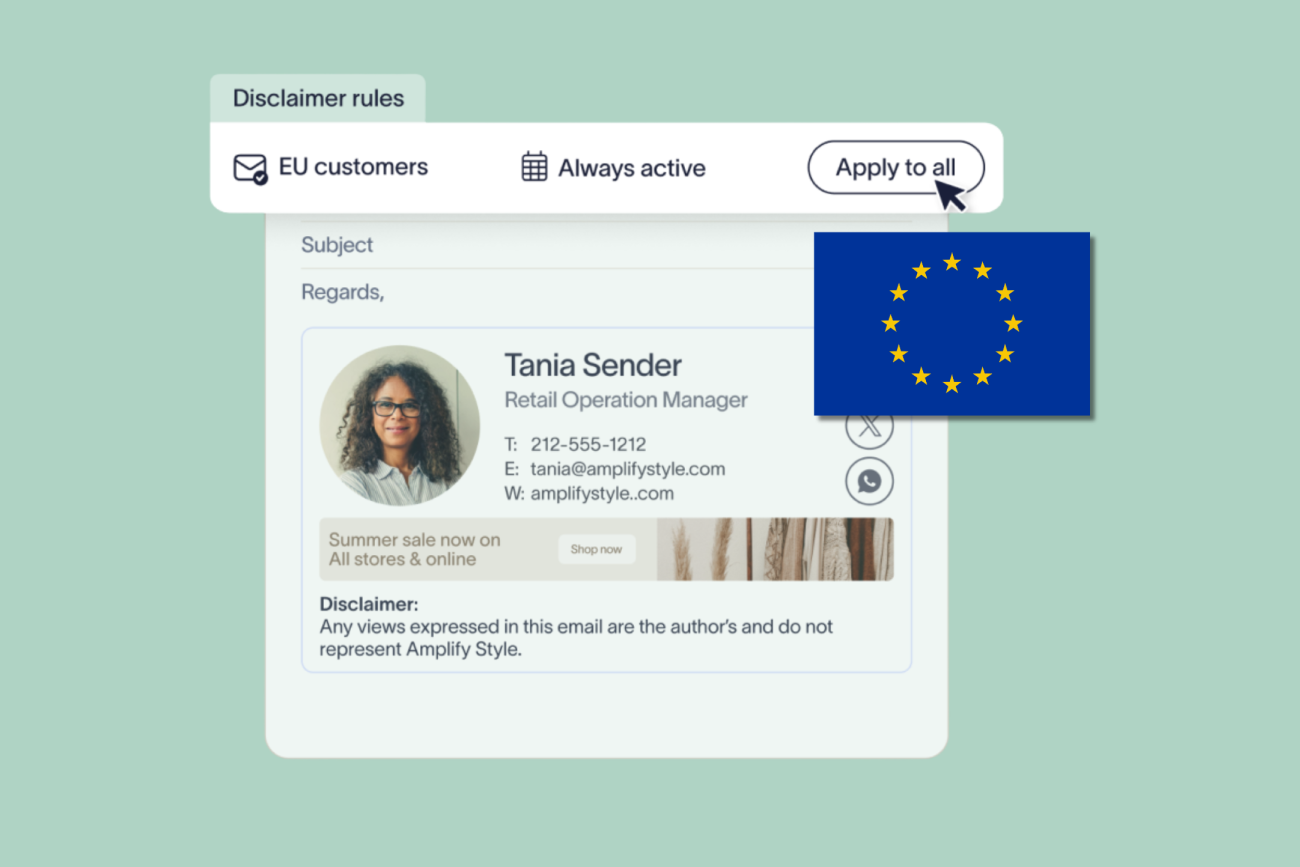
Email disclaimer guidelines in the European Union
Regulation | Details |
|---|---|
The General Data Protection Regulation (EU) 2016/679 | The General Data Protection Regulation (GDPR) is designed to protect personal data and privacy for individuals in the European Union (EU) and the European Economic Area (EEA). The primary goal of GDPR is to give individuals greater control over their personal data while holding companies accountable for handling it responsibly. While using a GDPR email disclaimer is not a mandatory requirement under GDPR, it can help businesses demonstrate compliance and build trust with recipients. Including an email disclaimer can also reinforce your company's commitment to GDPR compliance. |
EU Directive 2003/58/EC | The EU Directive 2003/58/EC, introduced in 2007, sets rules for business emails sent by companies within the European Union. Under this law, all business emails must include a legally compliant EU email disclaimer. The email disclaimer must contain the following information: the company's registration number, the place of registration, and the registered office address. |
Read the complete guide to European Union email disclaimers
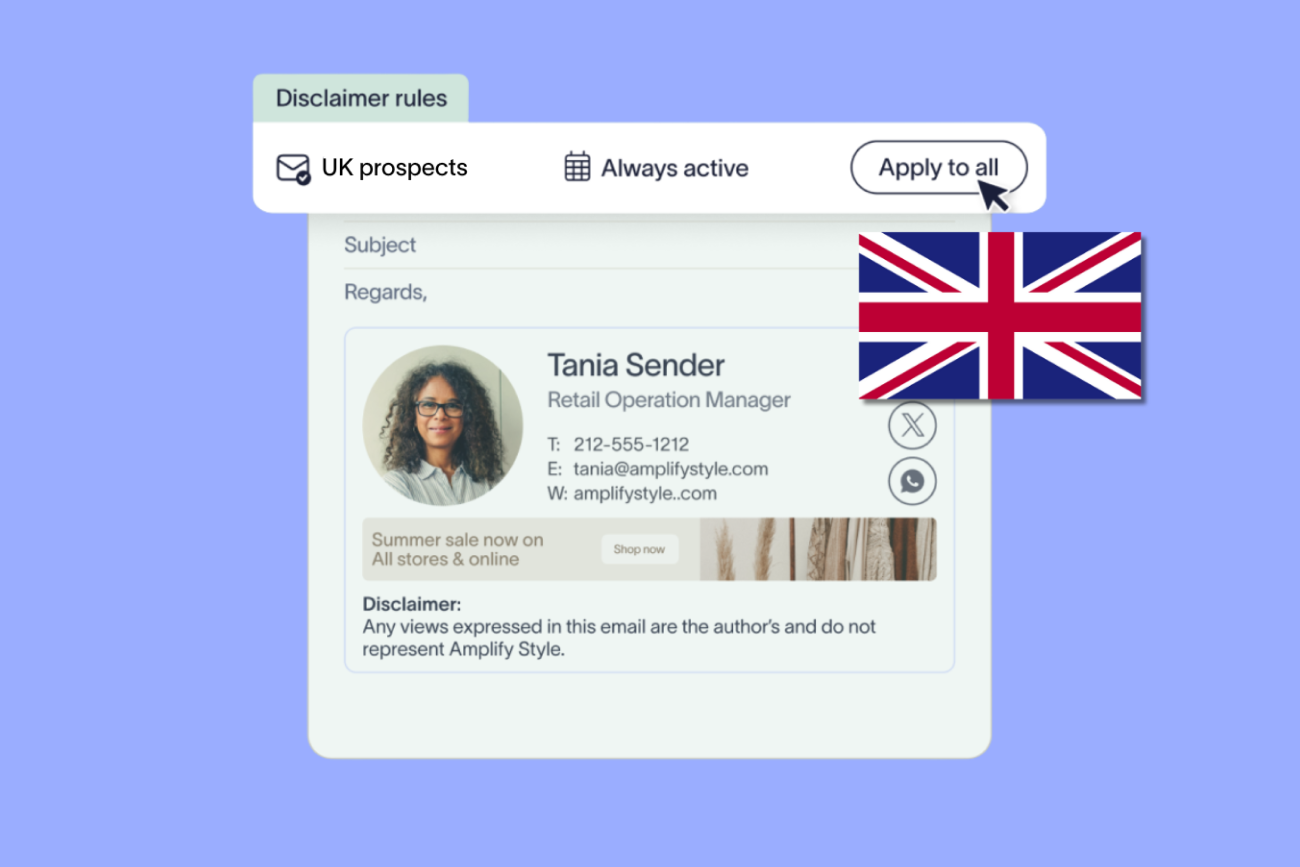
Email disclaimer requirements in the United Kingdom
Regulation | Details |
|---|---|
The UK Companies Act 2006 (amended 2007) | The UK Companies Act 2006 requires businesses to include specific company details (registered name, company number, place of registration, and registered office address) in business correspondence, including email. It doesn't require a general confidentiality-style disclaimer on top of that, but many UK organizations combine the two into one footer. This came into effect on January 1, 2007, implementing the EU Directive 2003/58/EC. |
The Financial Conduct Authority (FCA) Regulations | The Financial Conduct Authority (FCA) requires regulated firms to communicate with clients fairly, clearly, and without being misleading, a standard that applies to email under the FCA Handbook's COBS 4 rules. It doesn't mandate specific disclaimer wording, but firms often add regulatory status and risk-warning language to meet that standard consistently. |
Read the complete guide to email disclaimer laws in the UK
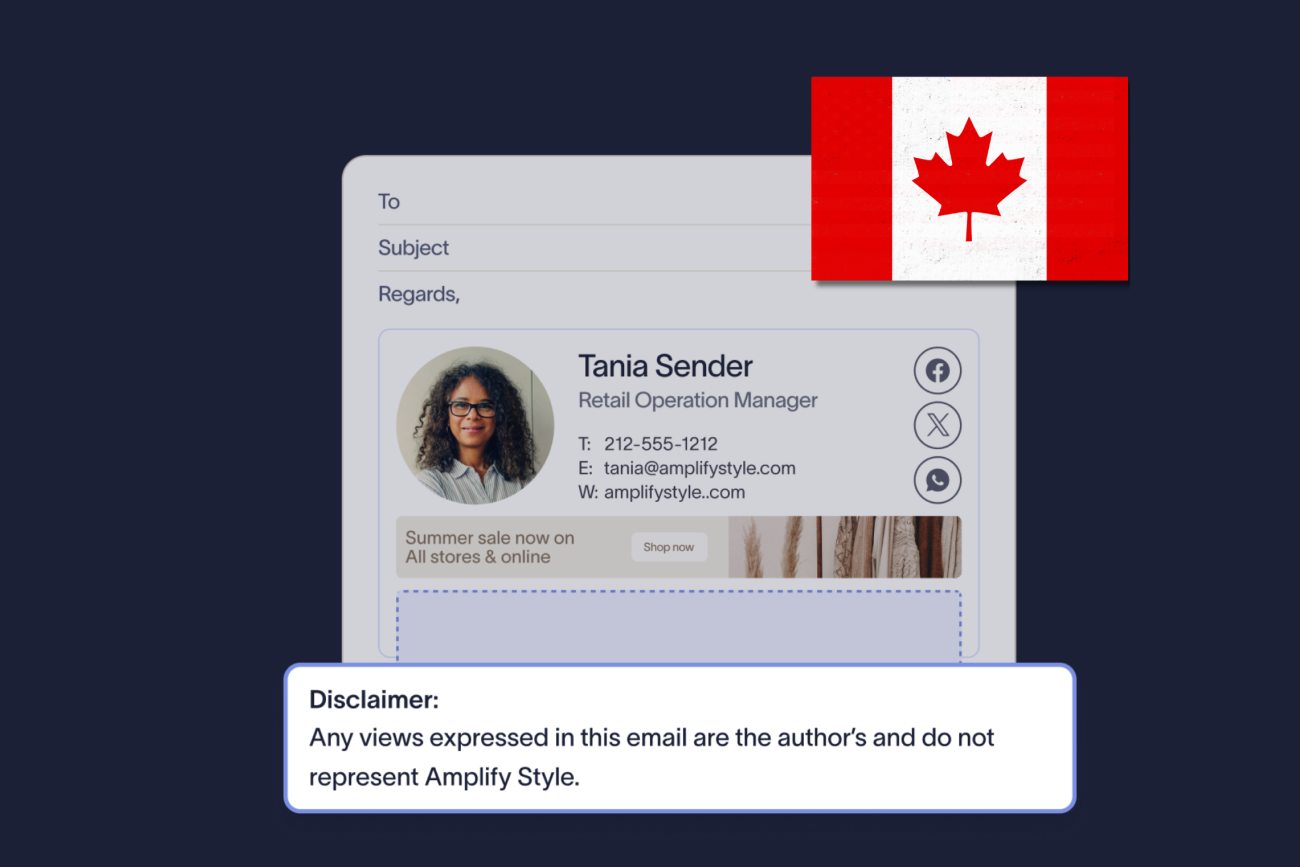
Email disclaimer rules in Canada
Regulation | Details |
|---|---|
Canada's Anti-Spam Law | Canada's Anti-Spam Law (CASL) doesn't require a general email disclaimer, but it does require every commercial electronic message, marketing and promotional email specifically, to identify the sender, include a valid mailing address, and provide a working unsubscribe mechanism that stays active for at least 60 days. A centralized email signature management solution helps apply this consistently to outbound marketing email without relying on individual senders. |
Personal Information Protection and Electronic Documents Act (PIPEDA) | PIPEDA is Canada's general private-sector privacy law, not a healthcare-specific one, and it doesn't require an email disclaimer either. It expects organizations to handle personal information, including health information where that applies, transparently and securely. Many organizations add a disclaimer to remind recipients that a message may contain personal data and should be handled with care, which supports PIPEDA's transparency principle without being required by it. |
Read the complete guide to email disclaimer laws in Canada
Other email disclaimer rules
Regulation | Details |
|---|---|
Personal Data Protection Act (PDPA) – Singapore | The Personal Data Protection Act (PDPA) is Singapore's general data protection law, covering all industries, not only healthcare, though health information is treated as especially sensitive in practice. PDPA doesn't require an email disclaimer, but many organizations, healthcare providers included, add one to flag that a message may contain personal data and to support the accountability the PDPA expects. |
My Health Records Act – Australia | Australia's My Health Records Act 2012 governs a specific national system, the My Health Record, rather than healthcare email generally, and it doesn't require an email disclaimer. Healthcare providers handling information from that system are subject to strict access-control and data-breach-notification obligations, and many add a disclaimer as a practical reminder that a message may contain sensitive medical information, though the disclaimer itself isn't what satisfies the Act's requirements. |
Health Information Privacy Code (HIPC) – New Zealand | The Health Information Privacy Code (HIPC) in New Zealand regulates how personal health information is collected, used, and shared. Adding a confidential email disclaimer to email signatures helps protect patient data, prevent misuse, and align with privacy laws. |
Tip
Even if not legally required, adding a disclaimer can support compliance and demonstrate your organization's commitment to data protection and transparency.
What happens if a company's emails are missing a legal disclaimer?
The largest fine on this list, $1.1 billion from the US Securities and Exchange Commission, had nothing to do with a badly worded disclaimer and everything to do with proof: the firms couldn't produce the business texts and emails they were required to keep. Every other case below follows the same shape: a regulator asked an organization to show what it told people, or prove it had their consent, and the organization couldn't.
Regulator | Entity | Date | Penalty | Specific failure |
| US Securities and Exchange Commission (SEC) | 15 broker-dealers and one investment adviser, including Bank of America Securities, Goldman Sachs, Morgan Stanley, and UBS | September 2022 | $1.1 billion combined | Employees conducted firm business over personal texting and messaging apps, and the firms failed to preserve those communications as required records |
| US Federal Trade Commission (FTC) | Verkada Inc. | August 2024 | $2.95 million, the largest CAN-SPAM penalty on record | Sent commercial email without a working unsubscribe option, without honoring opt-out requests, and without a physical postal address |
| UK Information Commissioner's Office (ICO) | Grocery Delivery E-Services UK Ltd (HelloFresh) | January 2024 | £140,000 | Sent more than 79 million marketing emails under a consent statement that didn't disclose email marketing, contravening Regulation 22 of PECR |
| France's Commission Nationale de l'Informatique et des Libertés (CNIL) | Orange SA | November 2024 | €50 million, covering this finding and a related one | Displayed advertising emails inside user inboxes designed to look like genuine messages, without the consent direct email marketing requires |
The SEC case above is the sharpest version of this pattern. Ed Bodey puts the general principle plainly:
"Inconsistencies between systems can increase exposure during audits and investigations. That might sound like a technical problem, but it is fundamentally a legal one. When an organization cannot show that its policies are applied consistently across communication channels, it becomes very difficult to defend its position when those communications are reviewed."
The FTC case traces to the same rules covered in U.S. Email Disclaimers. Regulators revisit these rules often enough that a disclaimer reviewed once and left alone tends to drift out of date faster than most legal teams expect.
Using internal email disclaimers
When most people think of email disclaimers, they picture external communication with clients, customers, or partners. But internal emails can also carry legal and reputational risk, especially in large organizations or regulated industries.
That’s why using internal email disclaimers is a smart move for reinforcing policies, reducing HR and legal exposure, and clarifying acceptable use.
“You might think a disclaimer only has to go to external recipients, but this is not accurate. There have been a number of lawsuits that have occurred due to offensive emails that have been sent internally. So, it's important to add an internal disclaimer, albeit one that differs from your external one.”
Why internal email disclaimers matter
Risk reduction: Internal emails can still be forwarded externally, intentionally or accidentally. Disclaimers help limit liability and define boundaries for sensitive or confidential communication.
Workplace protection: Disclaimers can reinforce acceptable use policies, protect against harassment or discrimination claims, and prevent misunderstandings around sensitive content.
Prevent inappropriate forwarding: A simple note like “Internal use only – do not share externally” can deter employees from forwarding messages that contain sensitive business information.
Tips for internal disclaimer usage
Use department-specific disclaimers: Customize disclaimers for HR, Legal, Finance, or IT depending on internal needs and risks.
Place disclaimers at the footer: Add it below the internal email signature to maintain readability.
Keep the language simple and direct: Avoid heavy legal jargon in internal disclaimers. The goal is clarity and enforceability, not formality.
Centralize management: Use software like Exclaimer to deploy and update internal disclaimers at scale across your organization.
Example:
This message is intended solely for internal use by [Company Name] employees. Any unauthorized distribution or disclosure is strictly prohibited. If you are not the intended recipient, please notify the sender immediately and delete this email.
Industry-specific email disclaimer laws
Different industries often have specific regulations and requirements for email disclaimers, covering compliance, sensitive information, and legal risk.
 These disclaimers can serve various purposes, such as maintaining confidentiality, limiting liability, or adhering to industry-specific standards.
Below are some of the industries where email disclaimer laws most directly affect communication and regulatory obligations:
| Healthcare | Financial Services | Law Firms / Legal |
| Construction | Insurance | Manufacturing |
Best practices for writing an email disclaimer
Creating a legally compliant and professional email disclaimer requires more than copy-pasting a generic block of text. It should reflect your industry requirements, local regulations, and internal communication standards.
 Follow these email disclaimer best practices to protect your business and avoid annoying your recipients:
1. Understand what is required in a disclaimer
An email disclaimer should include your company name, registered office address, and company registration details. For sensitive emails, add a confidentiality header at the top of the email, clearly stating for whom the message is intended.
2. Consult a legal expert
Regulations vary by country, industry, and use case. Always check with your legal team to confirm your disclaimer language meets compliance requirements and doesn’t create unintended liabilities.
3. Keep it concise and readable
Avoid legalese. Use plain language that is easy for recipients to understand. If your disclaimer is lengthy, link to a full version hosted on your website.
Good: “This email may contain confidential information. If you are not the intended recipient, please delete it and notify the sender.”
Bad: “The contents herein and associated annexures contain information which may or may not be classified in accordance with…”
4. Use a small, professional font
Use a small, web-safe font that is easy to read against a light background, ensuring your disclaimer doesn’t distract from your main message.
5. Separate your disclaimer from your email signature
Place the disclaimer after your signature and marketing elements (like banners or CTAs) to keep the email design clean. This avoids visual clutter and improves user experience.
6. Use plain text only
Always present your email disclaimer as plain text so it’s readable across all devices and email clients.
7. Tailor disclaimers to different teams
Different departments may need different disclaimers:
Sales: Quote expiration disclaimers
Legal: Privilege statements
HR: Confidentiality around applicant or personnel data
Finance: Non-binding payment terms or transaction liability language
8. Don't repeat the full disclaimer in every reply
A disclaimer that reappears on every reply and forward adds clutter, and it's a genuine pain point: IT admins often ask about escaping it directly in vendor support forums. To get around this, configure a disclaimer to apply only to the first message in a thread.
9. Update regularly
Regulations change. So should your disclaimers. Set a review schedule (e.g., quarterly or biannually) and use a centralized email signature management platform to push updates across your organization.
By following these email disclaimer tips, you’ll create a professional, compliant, and effective disclaimer that aligns with best practices.
Tip
With Exclaimer, you can automate dynamic email disclaimers per user, department, or region, applying the correct wording without manual updates.
Email disclaimer examples and templates
We’ve compiled detailed, copy-paste-ready examples to suit various industries and legal frameworks:
- Email disclaimer examples and templates
- GDPR email disclaimer examples
- HIPAA email disclaimer examples
How to manage email disclaimers at scale
Managing email disclaimers well is part of an organization's IT compliance strategy, and IT departments run into real challenges doing it.
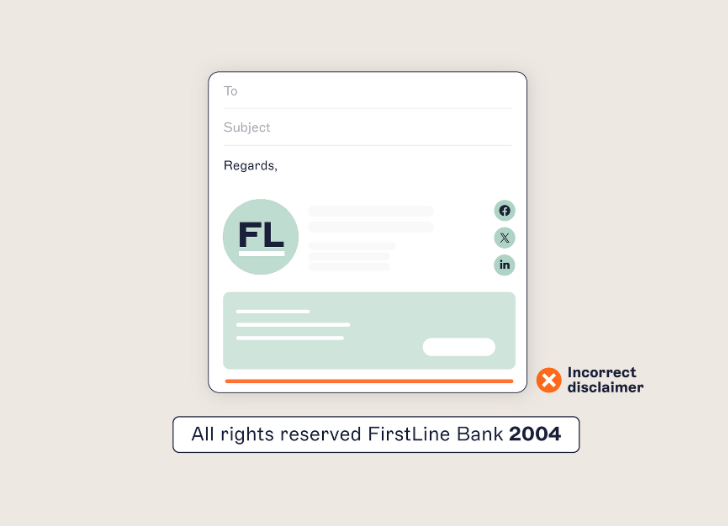
Manual processes often result in inconsistencies, outdated content, and exposure to legal risk. In the same Exclaimer study cited above, 35% of IT teams named signature and disclaimer management one of their top two most time-consuming tasks, yet 80% still handle it manually or leave it to individual employees, and only 18% use a centralized solution.
Common challenges of managing disclaimers manually
1. Time-consuming updates
Rolling out a new disclaimer across all user accounts or regions usually involves manual intervention by IT, costing time and increasing the risk of errors.
2. Inconsistent formats
Employees often create or edit their own disclaimers, leading to non-compliant or off-brand variations across departments.
3. Compliance across jurisdictions
Organizations operating in multiple countries need disclaimers that reflect local laws. Keeping up with international regulations manually is nearly impossible at scale.
4. Lack of visibility
Without centralized control, it's hard for legal or compliance teams to verify whether the correct disclaimers are being used consistently.
Why use Exclaimer for email disclaimers?
Native tools weren't built for the jurisdiction-specific version of this problem. Exchange transport rules and Google Workspace's own footer settings can each apply one static disclaimer, but neither offers rule-based targeting by department, region, or audience.
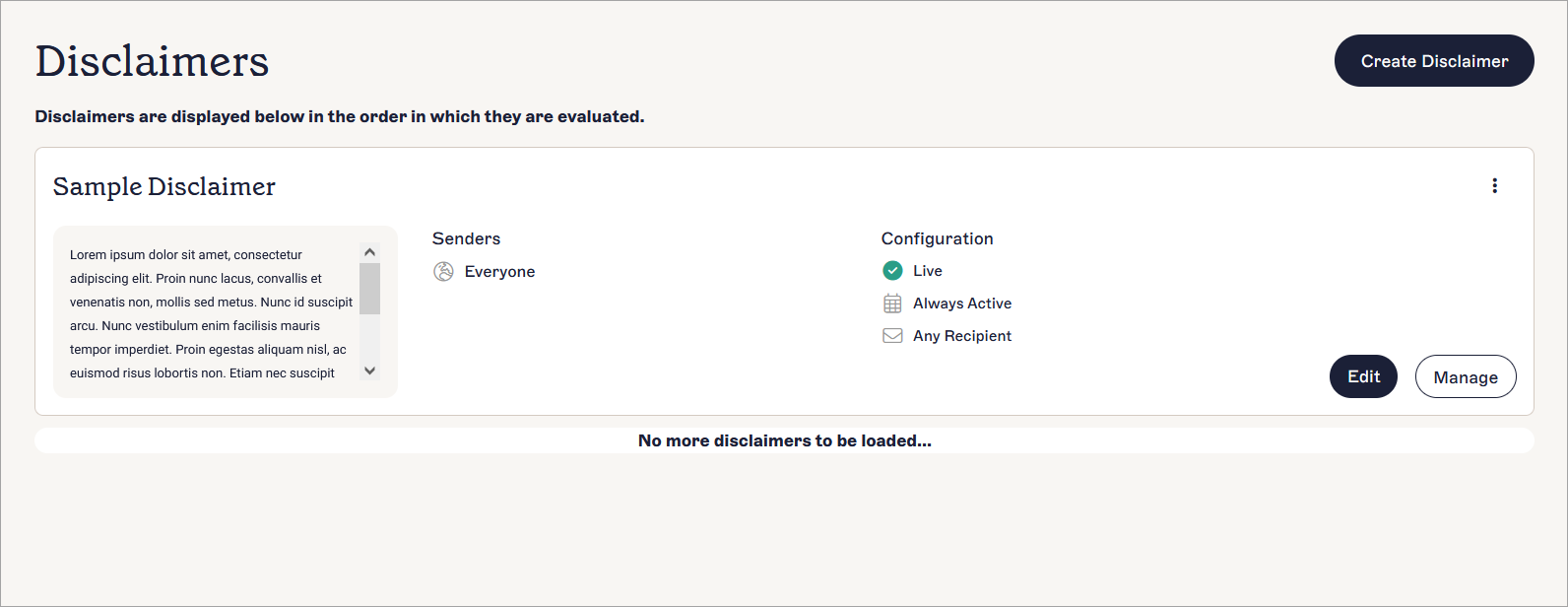
To address the challenges of managing email disclaimers, Exclaimer offers a platform built for simplicity, efficiency, and compliance.
Exclaimer applies your organization's disclaimers server-side, before an email leaves your network. That's the same disclaimer, in the same wording, regardless of device or email client, no matter who's sending it.
Exclaimer built the first-ever email signature software in 2001 and has spent 25 years on exactly this problem. Centralized updates remove the manual work of chasing down every mailbox when the wording changes, and the platform scales the same way whether you're managing fifty accounts or fifty thousand.
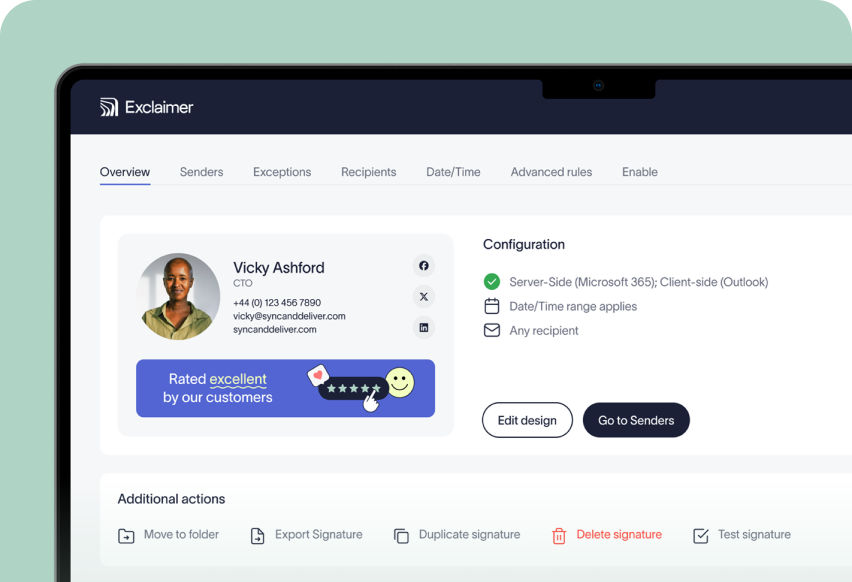
Confidential email disclaimers made simple. Exclaimer integrates with Microsoft 365 (Office 365), Google Workspace, and Microsoft Exchange, allowing IT teams to manage and update disclaimers from one interface. Centralized control keeps the wording consistent across every device and email client.
Consistent disclaimer wording across the organization. Because disclaimers apply server-side rather than relying on each employee's own client settings, IT and legal don't have to trust individual configuration to get the wording right on every device and every account.
Streamlined updates for email footers. Quickly update disclaimers, whether globally or for specific teams or departments, so your email footer disclaimer stays current across the organization.
Tailored disclaimers for specific needs. Create custom disclaimers for email confidentiality, tailored to teams, regions, or compliance requirements. Use directory attributes from Microsoft Entra ID or Google Workspace Directory to keep them accurate as people move teams or roles.
Exclaimer's Disclaimers feature supports legally compliant emails. It doesn't replace your legal team's judgment on what the wording should say, and, like any audit-log-based platform, it can show what's configured to send rather than serve as a courtroom record of exactly what left a specific mailbox on a specific date. What it does reliably is remove the variable that causes most disclaimer problems: relying on each person to apply the right text, correctly, every time.
Why email disclaimers still matter
Email disclaimers won't win an argument in court by themselves, and they won't stop every dispute. What they do is make your organization's policy provable, consistently, on every email, which is the part most businesses actually struggle with.
The theme running through this guide is the gap between having the right wording and actually applying it everywhere. That gap is where the real risk sits: a court weighing an informal email exchange, an auditor checking whether every department's disclaimer matches, or an AI tool drafting a message nobody reviewed for the right disclosure.
With centralized control, you can apply the right legal disclaimer to every outgoing email, cutting the risk of non-compliant messages leaving your business unnoticed.
Take your compliance efforts to the next level with Exclaimer’s email signature management software.